
 0
0
 0
0
www.tnsmi-cmag.com – A proposed national fuel reserve and new rules forcing more diesel to be held onshore are set to redefine how Australia secures its energy future, with agriculture at the center of the debate over cost, control and long-term resilience.
Fuel reserve policy: why Australia is rethinking diesel security
Australia’s reliance on imported fuel has long been a structural vulnerability. According to public data referenced by the International Energy Agency (IEA), Australia typically holds far fewer days of oil and fuel stock than many OECD peers. When COVID-era supply chain shocks and the Russia–Ukraine conflict rattled global energy markets, that vulnerability became impossible to ignore.
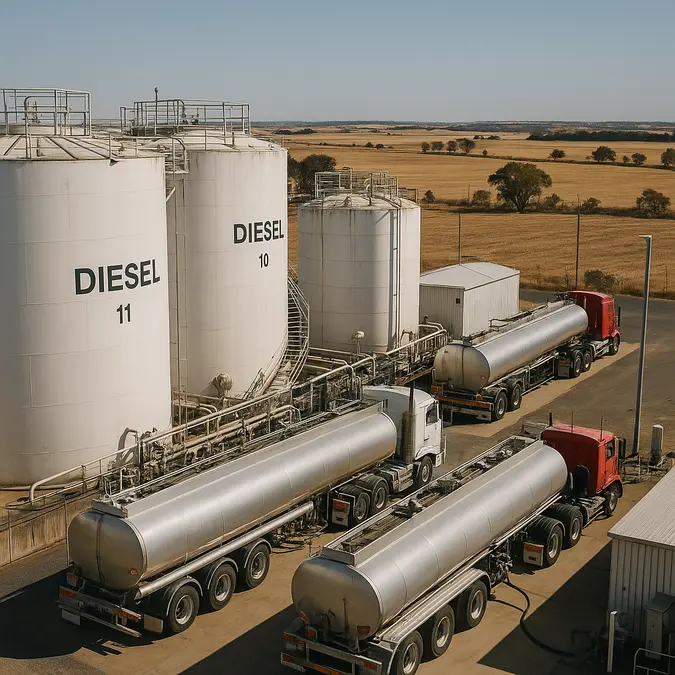
The federal government has now opened consultation on a national fuel reserve model that would compel higher onshore diesel stocks and potentially create a government-owned or government-directed reserve. For sectors that are fuel-intensive and time-sensitive – particularly broadacre farming, transport and mining – this is not an abstract policy exercise. It goes directly to the question: will fuel be there when it is needed most, and at what price?
At its core, the consultation considers whether Australia should move beyond market-only settings and adopt more strategic control over diesel, either through mandatory stockholding rules for private companies, a public strategic reserve, or a hybrid approach.
Fuel reserve and agriculture: why diesel is a lifeline, not a luxury
Australian agriculture depends heavily on diesel. From seeding and harvesting to hauling grain to port, diesel underpins productivity and timing. A delayed fuel delivery in the middle of harvest is not a minor inconvenience; it can turn prime conditions into lost yield.
For farmers, the question is not simply whether a fuel reserve exists on paper. The questions are:
- Can diesel be supplied locally, in sufficient quantities, during peak demand?
- Will new storage rules add costs to the supply chain that ultimately flow back to the farm gate?
- Will smaller regional distributors be squeezed out by compliance burdens?
This is why peak farming bodies and grower groups are watching the consultation closely. Is a government-owned reserve actually a solution to agriculture’s fuel security problems, or merely a political safety net that does little to improve real-world reliability?
How a national fuel reserve could work in practice
Although the detailed design is still under consultation, international experience offers several possible models for an Australian fuel reserve system. Many draw on variations implemented by countries that maintain strategic petroleum reserves or regulated stockholding obligations.
Fuel reserve models: key options on the table
Policymakers are effectively weighing four broad design choices:
- Government-owned strategic reserve: The state buys and stores fuel (or crude oil) directly in tank farms, underground caverns or contracted facilities. Release is tightly controlled and typically triggered only during severe supply disruptions.
- Mandatory industry stockholding: Fuel importers, refiners and major wholesalers are required by law to hold a minimum number of days of fuel stocks onshore. Compliance is audited and penalties apply for shortfalls.
- Ticketing / leasing schemes: Companies can meet some obligations by holding rights to fuel stored abroad (for example, leasing capacity in another country’s reserve) while still maintaining a defined share onshore.
- Hybrid models: Government maintains a core fuel reserve for emergencies, while industry carries a separate commercial stockholding obligation scaled to market share.
Each model comes with trade-offs in cost, control and market distortion. A purely government-owned reserve might provide a visible safety net but requires large upfront capital and ongoing management. A purely industry-led obligation might be cheaper for taxpayers but more complex to enforce consistently.
Where diesel stock must sit: onshore vs offshore
A central theme of the current Australian reform is location. While some previous arrangements allowed strategic stocks to be counted even if stored overseas, the new policy direction emphasizes holding more diesel physically onshore, closer to where it will be needed.
For regional Australia, including grain belts and pastoral regions, the key issue is distribution, not just national volume totals. Concentrating a fuel reserve near major import terminals alone may not help if supply chains to inland depots break down or if trucking fleets are short of fuel to haul product inland.
Robust policy will therefore have to consider:
- Minimum onshore days of cover for diesel specifically, not just total liquid fuels.
- Incentives and rules that support regional terminal and depot capacity.
- Coordination with state-based emergency management plans and rural supply networks.
Costs, prices and who ultimately pays for a fuel reserve
No strategic stockholding system is free. Whether through taxes, levies or higher wholesale margins, the cost of building and maintaining a fuel reserve will be borne by someone. The central questions for policymakers and industry are:
- How transparent will these costs be?
- Will competitiveness be preserved across the fuel supply chain?
- What protections will exist to prevent market manipulation around reserve releases?
Experience from other countries suggests that well-designed stockholding schemes can add only a few cents per litre when spread over time and volume. However, for fuel-intensive sectors such as agriculture, even minor increases can erode tight margins during droughts or low commodity price cycles.
Readers can expect intense debate over whether any fuel security levy should be uniform across sectors or whether energy-critical industries such as food production should receive targeted relief. Parallel discussions around energy transition – including electrification and biofuels – will shape how long-term these diesel-specific cost burdens appear.
Risk, resilience and the national interest
The consultation on a national fuel reserve opens at a time when governments worldwide are revisiting resilience. From pandemics to geopolitical shocks, the assumption that global supply chains will always self-correct quickly has been badly shaken.
The United States Strategic Petroleum Reserve, for example, has been both drawn down and rebuilt in response to major market disruptions and policy debates. Europe has long maintained coordinated oil stockholding systems through the IEA framework. Australia is, in effect, catching up.
Risk planning now extends beyond simple “days of fuel in the tank” metrics. Policymakers increasingly consider:
- Cybersecurity threats to refineries, pipelines and fuel terminals.
- Extreme weather damage to coastal infrastructure and roads.
- Shipping chokepoints and maritime security in key import routes.
- Financial shocks that disrupt credit for commodity trading houses.
A credible fuel reserve strategy therefore needs to be integrated into broader national resilience planning, not bolted on as a stand-alone emergency cupboard.
What this means for regional communities and farm businesses
For regional Australia, the lived reality of fuel risk often shows up as:
- Last-minute allocation limits from suppliers during peak seasons.
- Higher prices compared with metropolitan centers.
- Longer lead times for deliveries, especially after heavy rain or flood events.
A reformed fuel reserve system will only be judged a success if it addresses these front-line concerns. That means:
- Ensuring regional access: Stockholding rules should encourage geographically diverse storage, not simply larger city tanks.
- Supporting smaller distributors: Compliance and financing mechanisms must not unintentionally push out independent rural fuel suppliers who know their local customers.
- Maintaining price transparency: Farmers and transport operators need clear, predictable pass-through of any levies or reserve-related costs.
Some producer groups may also argue for explicit agricultural representation in advisory structures overseeing the fuel reserve, ensuring that on-the-ground realities feed directly into strategic decision-making.
Internal reforms, external shocks: the timing challenge
One of the most complex aspects of reforming Australia’s fuel reserve framework is timing. Building storage tanks, reconfiguring supply contracts and amending legislation all take years. Shock events, by contrast, can arrive overnight.
Readers should therefore view the current consultation as the first step in a multi-year transformation rather than an instant fix. Policymakers must strike a balance between ambitious long-term targets and pragmatic interim measures. For example:
- Short-term incentives for incremental stock build-up by existing importers and refiners.
- Medium-term investment programs to increase regional terminal and pipeline capacity.
- Long-term work to align fuel security with Australia’s decarbonization pathway, including alternative fuels and electrified machinery where feasible.
For deeper context on how commodity markets and energy policy intersect with rural economies, readers can explore our coverage in Energy and policy analyses under Economy.
Fuel reserve policy and the energy transition
Some might ask why Australia is considering more diesel-focused security at the very moment global policy is pushing toward decarbonization and net zero emissions. The answer lies in timelines and technology readiness.
Heavy-duty agricultural machinery, long-haul trucking and remote mining activities remain hard to electrify at scale in the short to medium term. Biofuels and renewable diesel are emerging but not yet ubiquitous or cost-competitive in all applications. As a result, diesel’s role as a workhorse fuel will likely persist for many years, even under ambitious climate scenarios.
A robust fuel reserve strategy does not contradict climate policy; it complements it. Energy transition will be politically and socially impossible if basic reliability in food production, freight and emergency services is compromised. The challenge for policymakers is to ensure that diesel security measures are flexible enough to evolve as new technologies become viable.
What readers and industry stakeholders should watch next
As the consultation progresses, several signposts will reveal the future shape of Australia’s fuel reserve regime:
- Legal architecture: Will legislation prioritize a pure stockholding obligation, a government-owned reserve, or a mixed model?
- Onshore targets: How many days of diesel cover will be mandated, and will there be specific provisions for remote and regional areas?
- Funding mechanisms: Will a dedicated levy, budget appropriation or hybrid funding scheme be used to pay for storage and management?
- Governance and transparency: What independent oversight, reporting frameworks and audit mechanisms will be put in place?
Stakeholders across farming, logistics, mining and emergency services have a narrow but important window to influence these decisions through submissions and direct engagement.
Conclusion: fuel reserve reform and Australia’s strategic resilience
Australia stands at a pivotal moment in reshaping how it thinks about liquid fuel security. The move toward a more structured fuel reserve framework is not just a technical regulatory tweak; it is a statement about national priorities in an increasingly uncertain world.
If designed well, a modern fuel reserve regime can provide insurance against global shocks, support regional resilience and give agriculture the confidence it needs to invest and expand. If implemented poorly, it risks adding cost without delivering real security on the ground. Readers should expect rigorous debate as governments, industry and communities navigate these trade-offs and decide what level of protection they are willing to fund in order to safeguard Australia’s economic and food security.