
 0
0
 0
0
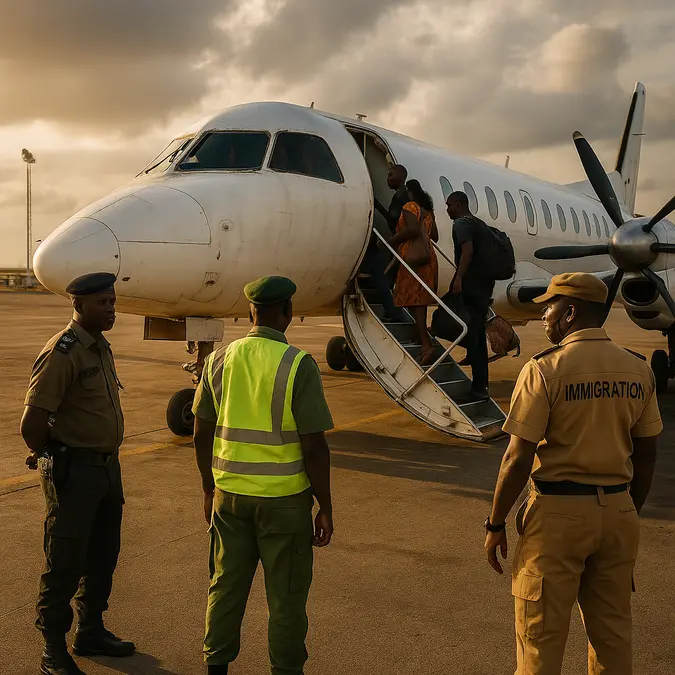
www.tnsmi-cmag.com – The recent controversy over a deportation flight from the United States to Liberia, where five individuals reportedly refused to deplane and were subsequently flown to Equatorial Guinea, highlights how migration enforcement, diplomacy, and human rights are colliding in real time.
According to reports, the Trump administration has initiated a new agreement enabling the U.S. government to deport up to 1,200 citizens of various African nations. The first flight under this arrangement allegedly carried deportees to Liberia, but the refusal of several passengers to disembark led to a highly unusual outcome: diversion to another African country, Equatorial Guinea. This single incident opens a window into broader questions about how deportation systems operate, the rights of those on board, and the geopolitical stakes for the United States and African partner states.
Deportation Flight Agreements: How U.S.–Africa Removal Deals Work
To understand the significance of this particular deportation flight, we need to step back and examine the architecture of U.S. deportation policy. The United States regularly negotiates return and readmission agreements with foreign governments to facilitate the removal of people who have no legal right to remain in the country. These agreements can be formal treaties, memoranda of understanding, or informal arrangements that align with existing immigration laws and bilateral relations.
In the African context, such agreements are often politically sensitive. Many African governments face domestic criticism when they accept deportees from Europe or the United States, particularly when returns occur under controversial circumstances or when citizens perceive that their compatriots were treated inhumanely. Yet, these governments also rely on good diplomatic and economic relations with Washington, which can include cooperation on counterterrorism, development aid, and trade.
Historically, countries that refuse to accept their nationals can face U.S. visa sanctions. Under Section 243(d) of the U.S. Immigration and Nationality Act, Washington can restrict visas to nations that deny or unreasonably delay accepting deportees. This legal tool, referenced in policy discussions and covered extensively in outlets like Reuters, gives the United States leverage in these negotiations, including with African states that rely on travel and exchange with America.
In this particular case, the new deal reportedly allows up to 1,200 people to be deported to Liberia and other African countries. That number is modest relative to global migration flows, but symbolically it is significant: it signals a tougher enforcement posture and a willingness by partner countries to cooperate with U.S. migration control strategies.
Deportation Flight Incident: What We Know About the Liberia–Equatorial Guinea Case
The incident at the heart of this story involves a U.S. deportation flight bound for Liberia, carrying multiple individuals designated for removal. According to available reports, five of those on board refused to deplane upon landing. Instead of forcing them off the aircraft at that moment, authorities allowed the flight to continue onward, ultimately arriving in Equatorial Guinea.
While the details remain incomplete and some information resides behind paywalls, we can piece together several likely dynamics based on established patterns of deportation operations:
- Chartered flights: Deportations of groups are often conducted via chartered planes rather than commercial flights, minimizing disruptions and increasing control.
- Escorted removals: Immigration enforcement agents typically accompany such flights to manage security and ensure cooperation.
- Multi-stop routes: It is not uncommon for a deportation flight to stop in multiple countries to disembark different groups, particularly across regions like West and Central Africa.
The twist here is the active refusal of five individuals to leave the plane at the intended destination. That resistance raises a series of questions: Were they Liberian nationals or citizens of another country? Did they assert fear of persecution if returned? Did they request asylum or protection? And on what legal basis were they then flown to Equatorial Guinea instead?
Equatorial Guinea, a small oil-rich nation in Central Africa, has faced steady criticism from human rights organizations for governance and civil liberties issues. Its profile is well documented in resources such as Wikipedia’s Equatorial Guinea entry, which aggregates decades of reporting and analysis. Sending individuals there, particularly without clear transparency on their legal status, is bound to attract scrutiny from rights advocates and migration scholars.
Legal and Human Rights Questions Raised by the Deportation Flight
At the core of this deportation flight incident lie several legal and ethical questions that go far beyond one plane and five passengers. They touch on key international principles, such as the prohibition against refoulement—the forced return of someone to a country where they face persecution, torture, or serious harm—as recognized under the 1951 Refugee Convention and other human rights instruments.
Deportation Flight Rules: Rights of Passengers Who Refuse to Deplane
When individuals on a deportation flight refuse to disembark, they are not simply unruly passengers; they may be making a last-ditch assertion of fear, rights, or personal security. International and domestic law, including U.S. statutes and precedents, generally requires authorities to:
- Screen for protection claims: If someone expresses fear of return, there is usually an obligation to assess whether they might qualify for asylum or other forms of protection.
- Respect due process: Deportation is the final phase of a legal process. Any new evidence, changed circumstances, or procedural errors can, in theory, reopen a case.
- Ensure safe and orderly transfer: Even during removal, states must respect minimal human rights standards, including humane treatment and access to basic needs.
However, observers know that what the law prescribes and what happens in the confined, highly controlled environment of a deportation flight often diverge. There is limited public visibility once the aircraft doors close. Independent monitors rarely accompany such flights, although some European countries allow NGOs or ombudsman offices to observe.
In the U.S. context, advocates have long called for more transparency around in-flight conduct, use of restraints, and how officers respond when deportees resist. A case where five individuals stand their ground and refuse to deplane provides an illustration of these unresolved tensions.
Diplomatic and Political Stakes for Liberia and Equatorial Guinea
The political implications for the African countries involved in this deportation flight are complex. Liberia, with its historic ties to the United States, often attempts to balance domestic concerns with the expectations of a powerful partner. Accepting deportees can trigger local backlash, particularly when returnees are portrayed as criminals or when the economy struggles to absorb them.
Equatorial Guinea finds itself in an arguably more delicate position. Accepting individuals diverted from a deportation flight that was originally headed to another country could raise accusations of acting as a convenient “offshore” destination for U.S. migration enforcement. Without clarity on nationality, legal status, and consent, such cooperation risks being perceived as transactional rather than rights-based.
These dynamics form part of a wider global negotiation over migration control. Wealthier nations often seek “migration partnerships” with governments in Africa, Latin America, and Asia, sometimes offering development aid, security cooperation, or diplomatic support in exchange for accepting deportees or hosting processing centers. Our readers can explore broader geopolitical context and regional coverage in sections such as Africa on our site.
Media Narratives, Language, and Public Perception
The wording used to describe this incident also deserves careful attention. Reports refer to the passengers as “illegals”—a loaded term that has become central to the political rhetoric around migration. Many news organizations and policy bodies now avoid the term, preferring “undocumented migrants,” “irregular migrants,” or simply “non-citizens” in order to focus on legal status rather than identity.
Language choices shape how the public understands an event like this deportation flight. Describing people as “illegals” can implicitly criminalize their existence rather than their actions, whereas more neutral terms invite readers to focus on the laws, institutions, and policies at play. That shift matters when we evaluate whether a deportation is necessary, fair, or lawful.
Contrary to popular belief, the core legal question is not whether someone crossed a border without authorization at some point, but whether they currently have a valid legal basis to remain and whether returning them would violate fundamental rights.
This distinction is crucial in an era of polarized political debates about immigration. Detailed, fact-based reporting and analysis allow readers to move beyond slogans to engage with the real mechanics of policy.
Operational Challenges: Security, Logistics, and Compliance
From an operational perspective, deportation flights represent one of the most complex tools in the migration enforcement toolbox. Authorities must coordinate between multiple agencies—immigration services, law enforcement, airport authorities, and foreign ministries—to ensure that each flight meets legal and practical requirements.
When individuals on a deportation flight refuse to deplane, that complexity increases sharply. Officers must decide whether to use force to remove them, delay disembarkation, or proceed to another stop on the flight plan. Each choice carries consequences:
- Use of force: Can trigger injuries, legal complaints, and reputational damage if video or witness accounts surface.
- Delays on the ground: Can disrupt airport operations and raise questions from local authorities and media.
- Continuation of the flight: Raises legal concerns about where those individuals ultimately end up and under what jurisdiction.
In the reported Liberia–Equatorial Guinea case, the decision to continue flying with five resistant passengers suggests that authorities prioritized onward movement over immediate resolution. That approach may have reduced confrontation at one stop but postponed the underlying questions of consent, legal status, and destination.
Our coverage within Politics often underscores how operational decisions in law enforcement and migration control can quickly turn into diplomatic flashpoints and domestic political debates, especially when they intersect with human rights concerns.
Policy Implications: What This Deportation Flight Tells Us About the Future
Looking ahead, this deportation flight incident offers several lessons for policymakers in Washington and across African capitals. First, it reveals the need for greater transparency around bilateral agreements that enable mass removals. Public understanding of how many people are affected, what rights they retain, and how receiving countries are supported remains limited.
Second, the incident shows that individuals slated for removal are not passive actors. Their resistance—whether driven by fear, principle, or desperation—can alter the trajectory of enforcement. Policy frameworks must anticipate such resistance and establish safeguards to ensure that last-minute claims of fear receive serious consideration.
Third, the episode underscores the reputational risks for all governments involved. In an age where social media and investigative journalism can quickly amplify a single case, any perception of “outsourcing” human beings to countries with contested rights records can spark domestic and international backlash.
Finally, this moment invites a re-examination of the balance between border control and human dignity. States have the right to regulate entry and stay; that principle is widely recognized in international law and practice. Yet, how that right is implemented—on the tarmac of an African airport, inside the cabin of a charter plane, or in the paperwork of a bilateral deal—will determine whether enforcement is viewed as legitimate or abusive.
Conclusion: Why This Deportation Flight Matters Beyond One Plane
The story of a single deportation flight from the United States to Liberia, diverted to Equatorial Guinea after five passengers refused to step off the aircraft, is far more than a curiosity in the news cycle. It crystallizes many of the most pressing tensions in contemporary migration governance: the power of states versus the rights of individuals, the leverage of powerful nations in negotiations with smaller partners, and the role of language and media in shaping public perception.
For readers, the key takeaway is that deportation is not merely an administrative action; it is a deeply political and human process that unfolds at the intersection of law, diplomacy, and lived experience. As new agreements expand the scale and reach of such flights—potentially affecting up to 1,200 people in Africa and beyond—ongoing scrutiny, transparent reporting, and informed public debate will be essential.
Ultimately, this deportation flight reminds us that how societies remove people can be as revealing as how they welcome them. The standards we apply in these moments will shape not only migration outcomes but also our broader commitment to human rights, rule of law, and international partnership.