
 0
0
 0
0
www.tnsmi-cmag.com – The census religion question in Australia has quietly shaped how governments fund services, how politicians calculate their support base, and even how we see ourselves as a nation — yet mounting evidence shows this single question is deeply flawed and systematically distorts reality.
Census religion question and why it matters for Australia in 2026
Every five years, the Australian Census offers an x-ray of the nation. One question, however, carries outsized influence: the census religion question. On the surface, it seems simple — “What is the person's religion?” — but the structure, wording, and position of this question have created inflated religious affiliation numbers and misled policy-makers for decades.
In a country where funding for schools, hospitals, chaplaincy programs and social services frequently relies on religious affiliation statistics, the stakes are high. When the data is skewed, public money and political attention follow those distortions. That is why Australia's census religion question is not just a technical quirk; it is a public policy problem.
Internationally, similar debates have emerged in countries such as the United Kingdom and United States, where researchers have shown how small wording differences dramatically alter reported religiosity. Australia is now confronting its own version of that challenge.
How the census religion question is structured — and why that matters
To understand the controversy, readers need to look closely at how the census religion question is actually framed. Historically, the Australian Census has:
- Placed the religion question after demographic and cultural items such as ancestry and language.
- Presented a tick-box list of major Christian denominations first (for example, Catholic, Anglican, Uniting Church).
- Included "Other religions" as a category.
- Placed "No religion" as a single option, often at the bottom of the list or as an alternative field.
This design is not neutral. Survey methodologists know that question order and visual layout can nudge respondents. When religion appears as though it is expected — and when established churches are highlighted first — people with weak, cultural or historical connections to religion may tick an option by default, rather than leaving the question blank or choosing "No religion."
Furthermore, older versions of the census religion question did not clearly signal that the question was optional. In practice, many respondents assumed that they had to pick something, reinforcing inflated religious counts.
Census religion question bias: leading, loaded and outdated
The census religion question has long reflected an era when Australia saw itself primarily as a Christian nation. That assumption is now badly outdated. Yet the design of the question still nudges people toward religious labels, particularly Christian ones, even when their actual belief or practice is minimal.
Several methodological biases are at work:
- Primacy effect: Catholics and Anglicans often appear at the top of the list, benefiting from "first option" bias.
- Social desirability bias: Older Australians, migrants from religious societies, and people in conservative communities may feel subtle pressure to identify with a religion, even if they rarely attend services.
- Cultural identity confusion: Some respond based on their family background ("I was raised Catholic") rather than their current belief ("I do not believe or practice anymore").
- Layout bias: When "No religion" appears last, visually separated or less prominent, it signals that it is an exception, not a normal choice.
Survey experts across academia and government have described this as a classic case of a "leading question" — one that pushes respondents toward a predefined narrative. In this case, the narrative is that Australia is much more religious than it actually is.
The growing gap between census religion question results and real belief
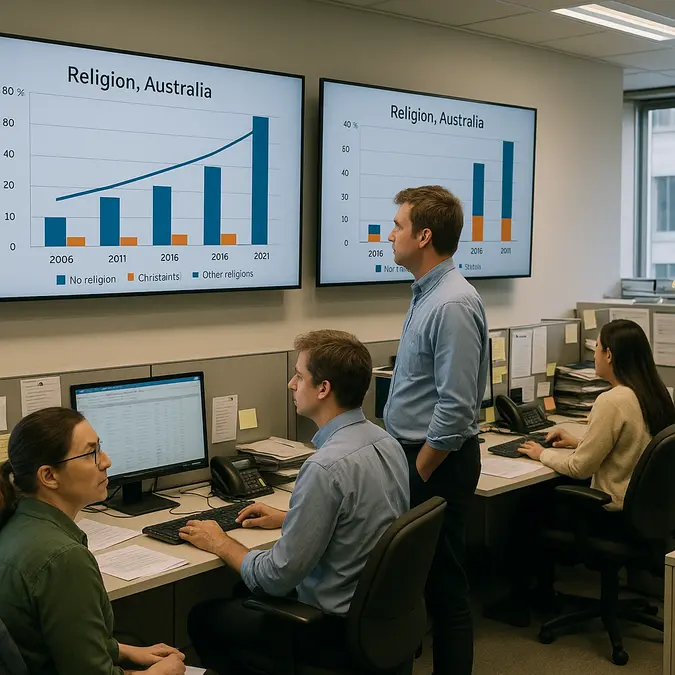
Over the past two decades, independent surveys using more neutral wording have consistently shown a higher proportion of non-religious Australians than the official census figures suggest.
For example, large-scale social attitudes surveys that ask "Do you have a religion or religious belief?" — with yes/no options offered equally — typically register significantly more "No religion" responses than the census. When researchers dig deeper, they find large groups who ticked "Catholic" or "Anglican" on the census but describe themselves as atheist, agnostic or simply "not religious" in other contexts.
In effect, the census religion question has created a statistical mirage — a picture of a nation still anchored in traditional churches, while lived reality has shifted toward secularism, pluralism and private spirituality.
Contrary to popular belief, this is not a minor statistical quibble. The gap between genuine belief and reported affiliation translates directly into how governments direct billions of dollars in funding and how political parties court so-called "religious voters."
Census religion question and distorted funding decisions
Religious affiliation statistics guide a vast ecosystem of public and quasi-public spending. When the census religion question inflates religious numbers, it strengthens the lobbying power of institutions that depend on those figures. Key areas affected include:
- School funding: Enrollment projections, chaplaincy grants and support for faith-based schools are often justified with reference to local religious composition.
- Health and aged care: Religious providers in hospitals and retirement homes receive public funds based partly on assumptions about the "needs" of religious populations.
- Social services and charities: Faith-based organisations compete for government contracts to deliver welfare programs, citing census data to back claims of community representation.
When census religion question data overstates Christian affiliation, it can:
- Divert resources from secular, Indigenous or non-religious service providers.
- Underestimate demand for services that do not assume religious belief, such as secular counselling or non-religious aged-care options.
- Legitimise religious preferences — for example, prayer rooms or chaplaincy — even where a majority of local residents may not want them.
Readers following our coverage of public policy will recognise the pattern: when data is flawed, systems built on that data become inequitable. This dynamic directly intersects with broader themes we explore on Politics and evidence-based governance.
Census religion question and political power
The census religion question also plays a quiet, but potent, role in political strategy. Parties analyse census data to profile electorates, identify "values voters" and craft messages around issues such as religious freedom, faith-based schooling and moral legislation.
Inflated religious data can:
- Encourage parties to over-emphasise religious agendas in marginal seats.
- Amplify the influence of religious lobby groups claiming to represent "millions of believers."
- Mask the rising diversity of worldviews, including non-religious, spiritual-but-not-religious and minority faith communities.
Furthermore, parliamentarians who rely on census figures may believe they are responding to the "will of the people" when, in reality, they are responding to statistical artefacts produced by a flawed census religion question.
International lessons: how other countries fixed their religion questions
Australia is not alone in confronting these issues. Other Western democracies have progressively modernised their census religion question to reduce bias and reflect changing societies.
Key approaches include:
- Putting "No religion" first: In New Zealand, placing "No religion" at the top of the response list led to a significant jump in non-religious responses, widely regarded as a more accurate reflection of reality.
- Clearer wording: Some countries now ask, "What is your present religion, if any?" emphasising current belief rather than cultural heritage.
- Two-step questions: A first question may ask whether a person has a religion at all, followed by a second that identifies which religion for those who answer "yes."
- Equal visual weight: "No religion" is treated as a standard, non-stigmatised response option, displayed with the same prominence as major faiths.
These reforms are backed by rigorous testing, including cognitive interviews and pilot surveys that measure how different versions of the census religion question change responses. The evidence is consistent: neutral wording and layout result in lower reported religiosity but higher data quality.
Reforming the census religion question: 5 critical changes Australia needs
Given the mounting evidence of distortion, what should Australia do? Based on international best practice and survey science, five critical reforms stand out for the census religion question:
1. Make the question explicitly optional and clearly marked
Respondents should see a prominent note stating that the census religion question is optional. This respects privacy and belief freedom while reducing pressured or careless answers. When people know they can skip a question, their decision to answer becomes more deliberate and meaningful.
2. Place "No religion" at the top of the list
Reordering the response options so that "No religion" appears first would tackle the primacy effect head-on. This does not push people toward non-belief; it simply counters decades of layout bias that pushed them toward established churches.
3. Use present-tense, belief-focused wording
The question should focus clearly on current belief and practice, for example: "Do you currently have a religion or religious belief?" followed, if "yes," by "Which religion or religious tradition do you identify with most?" This two-step formulation aligns with the way social scientists distinguish between nominal identity and active belief.
4. Expand and modernise categories
Australia's religious landscape is now highly diverse. Beyond Christianity, Islam, Buddhism and Hinduism, many people identify with newer or less institutionally organised traditions, as well as with "spiritual but not religious" or "humanist" outlooks. A reformed census religion question should:
- Include a wider set of recognised options.
- Allow multiple affiliations where relevant.
- Provide a clear write-in field for "Other (please specify)."
5. Commit to transparent testing and public consultation
Any change to the census religion question must be evidence-based and transparent. The Australian Bureau of Statistics should publish the results of test surveys, invite input from religious groups, secular organisations, demographers and survey experts, and explain clearly why a final design was chosen.
This is not merely a technical exercise. It goes to the heart of public trust in official statistics, a recurring theme in our coverage of Economy and governance data.
Media, narratives and the myth of a "Christian majority"
The media has long relied on census figures to describe Australia as a "Christian-majority nation." Stories on ethics, social policy and culture wars often open with lines about the views of "millions of Christians," heavily influenced by the inflated numbers produced by the current census religion question.
However, when non-biased surveys are considered, a different picture emerges: a rapidly growing non-religious population, a shrinking but still significant Christian bloc, and increased representation of non-Christian faiths. This more complex reality reshapes debates around:
- Marriage equality and LGBTQ+ rights.
- Voluntary assisted dying and end-of-life care.
- Religious freedom, anti-discrimination law and hate speech rules.
When the census religion question exaggerates religious affiliation, conservative religious arguments can appear to carry more democratic weight than they genuinely do. Correcting the question is therefore also about correcting the public conversation.
Why accuracy in the census religion question is a democratic imperative
At its core, the census is a tool for democratic fairness. It informs how we share resources, craft laws and tell the story of who "we" are. When the census religion question distorts data, it undermines that mission.
Accurate religion data matters because it:
- Ensures funding for schools, hospitals and social services matches real community needs.
- Prevents any group, religious or secular, from claiming exaggerated representation.
- Allows honest debate about the role of religion in public life.
- Protects minority faiths and non-believers alike by making them visible in official statistics.
In an era where trust in institutions is fragile, reforming the census religion question is a straightforward, evidence-backed way to improve the integrity of public data.
Conclusion: The census religion question must catch up with modern Australia
Australia has changed dramatically in the past half-century. Urbanisation, migration, rising education levels and generational shifts have all contributed to a more secular, more pluralistic society. Yet the census religion question remains tethered to an earlier era, producing data that flatters traditional institutions while obscuring emerging realities.
For readers concerned with equitable policy, data integrity and democratic accountability, the path forward is clear. The census religion question needs transparent, research-driven reform: an optional, neutrally worded, modern design that treats "No religion" as a normal, visible choice and acknowledges the diversity of contemporary belief. Until that happens, Australia will continue to make billion-dollar decisions and shape national narratives on the basis of numbers that do not truly represent who we are.