
 0
0
 0
0
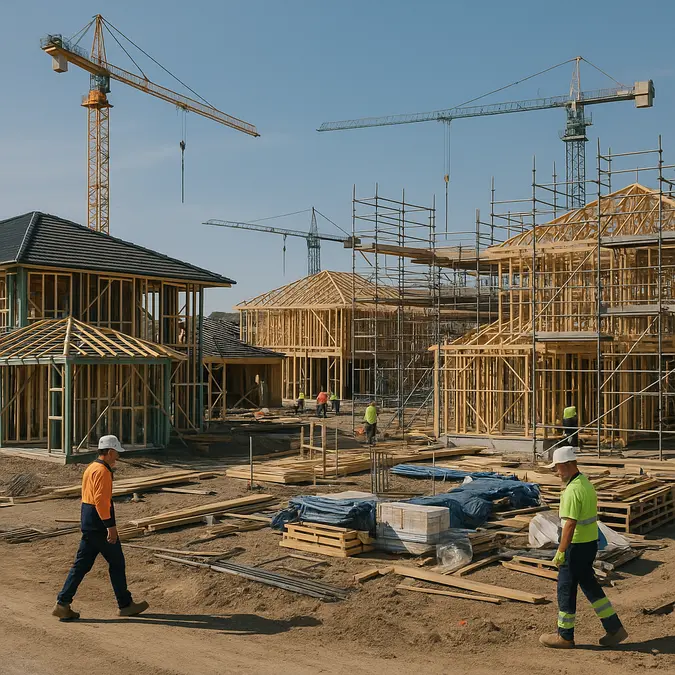
www.tnsmi-cmag.com – Australian home building has moved to the center of the country’s economic agenda, as fresh data shows the time to construct a new home has fallen by around 10 per cent in just two years, yet the nation is still falling short of its ambitious 1.2 million homes target.
Australian home building and why it dominates the economic agenda
Australian home building is no longer just a niche concern for developers and construction firms. It now sits at the heart of debates about inflation, interest rates, productivity, migration, and long-term social cohesion. When the Reserve Bank of Australia (RBA) prepares major speeches on the outlook for growth and prices, housing supply and construction conditions increasingly feature as core themes, not side notes.
The latest data, referenced in the national debate, indicates that the average time to build a new dwelling has shortened by roughly 10 per cent over the past two years. This improvement partly reflects easing material bottlenecks after the COVID-era supply chain shock and a modest normalization in labor availability. Yet even as build times improve, the country remains behind the pace needed to deliver 1.2 million well-located homes over a five-year horizon — a target agreed by federal and state governments to tackle worsening affordability.
For readers tracking Australia’s macroeconomic direction, this tension between faster construction cycles and an entrenched housing shortfall is crucial. It will influence RBA rate decisions, state and federal budget priorities, and even how infrastructure dollars are allocated around new transport and social services. As the economic agenda evolves, understanding the structural forces within Australian home building becomes a strategic advantage for investors, policymakers, and industry leaders.
Australian home building: 7 critical signals policymakers are watching
To unpack the role of Australian home building in the broader economy, we can break the current situation into seven critical signals that policymakers, businesses, and analysts are watching closely.
1. Australian home building timelines are easing, but not fast enough
At the headline level, a 10 per cent reduction in the time required to complete a new dwelling is encouraging. It suggests that the worst of the COVID-era disruptions — shipping delays, material shortages, and rolling lockdowns that halted work on site — has faded. Suppliers report better access to key inputs like timber, steel, and imported fixtures, while build pipelines have become more predictable.
However, construction times remain elevated relative to pre-pandemic norms. In many metropolitan markets, detached homes and larger townhouse projects still face delays linked to:
- Limited availability of skilled trades, such as electricians, plumbers, and carpenters
- Lingering backlogs at local planning and approvals offices
- Cost pressures that cause developers or builders to stage projects more cautiously
Historically, the relationship between construction time and housing supply is straightforward: longer build times reduce effective capacity, while shorter build times allow the same workforce and capital base to deliver more dwellings per year. As such, the modest improvement is welcome, but still insufficient to close the gap with the 1.2 million homes target.
2. The 1.2 million homes target highlights the scale of the challenge
Australia’s commitment to building 1.2 million new homes over five years is ambitious relative to recent performance. This objective, endorsed by the Australian governments at multiple levels, reflects concern over:
- Record population growth driven by post-pandemic migration
- Sharp increases in advertised rents in major cities
- Falling rental vacancy rates and growing social housing waitlists
To stay on track, Australian home building would need to sustain a much higher rate of new dwellings commencement and completion than historically observed. When current approvals, commencements, and completions are measured against the timeline, policymakers can already see a shortfall emerging. That shortfall has direct implications for affordability and household budgets, which in turn shapes wage demands, consumption patterns, and inflation dynamics.
Readers should see the 1.2 million target not as a political slogan but as a rough quantitative benchmark. It defines the scale of supply required just to prevent housing pressures from intensifying, let alone to unwind decades of under-building in certain segments, particularly social and affordable rentals.
3. RBA speeches are increasingly anchored in housing supply and rents
When the RBA addresses the public and financial markets, it has one eye firmly fixed on the housing sector. In recent years, rent inflation has become one of the stickier components of the Consumer Price Index (CPI), reflecting the mismatch between demand and available homes. As the central bank weighs interest rate settings, it must differentiate between demand-driven inflation and supply-side cost pressures.
Housing is a textbook example of how supply constraints can keep prices elevated even when demand growth slows. If Australian home building fails to keep pace with population and household formation, higher rents may persist despite tighter monetary policy. That makes it harder for the RBA to bring inflation sustainably back within its target band without disproportionately squeezing other parts of the economy such as small business investment and discretionary consumer spending.
We have seen similar dynamics in other advanced economies. In the United States, the Federal Reserve has repeatedly highlighted the role of shelter costs in inflation metrics, as documented in numerous analyses by sources such as the Reuters economics desk. Australia is not immune to these global patterns; RBA speeches now routinely acknowledge that effective solutions require coordination between monetary policy, fiscal policy, and structural reforms in planning and housing.
4. Australian home building as a powerful economic multiplier
Beyond prices and rents, Australian home building plays a critical role as an economic multiplier. Residential construction directly employs large numbers of workers and indirectly supports industries ranging from building materials and transport to legal and financial services. When a new estate, mid-rise apartment block, or infill project proceeds, the local economy benefits through:
- Job creation for trades, engineers, designers, and project managers
- Demand for inputs such as cement, glass, insulation, and fittings
- Increased activity in conveyancing, surveying, and lending
- Long-term spending in nearby retail and services once residents move in
Conversely, when housing approvals and commencements fall, the slowdown can ripple across many sectors. That is why state and federal governments often consider targeted incentives for Australian home building when growth softens — including grants for first-home buyers, tax concessions for build-to-rent, or accelerated approvals for shovel-ready projects.
Yet policy support must be calibrated carefully. Overly generous subsidies can stoke demand without addressing supply bottlenecks, feeding higher prices rather than more completions. The challenge today is to design measures that expand capacity, modernize construction methods, and streamline regulation, rather than simply boosting bidding power in an already constrained market.
5. Labor shortages and productivity in Australian home building
Many of the structural obstacles to faster Australian home building sit in the labor market. Builders report persistent difficulty recruiting experienced tradespeople, while younger Australians often face conflicting incentives around entering apprenticeships versus university pathways. Demographic shifts, including retirements among older trades, exacerbate these gaps.
At the same time, the industry must contend with relatively low measured productivity growth. While sectors such as manufacturing and information technology have rapidly adopted automation and digital tools, construction has traditionally been slower to transform. There are promising innovations — modular housing, factory-built components, and digital project management platforms — but take-up is uneven.
Readers looking at the medium-term outlook should pay close attention to whether governments and industry bodies can accelerate training, reform licensing, and encourage modern building techniques. A more productive and better-resourced workforce would allow Australian home building to deliver more homes, faster and at lower unit cost, without relying solely on cyclical booms in migration or fiscal stimulus.
6. Planning, zoning, and the politics of density
Even if build times and labor capacity improve, Australian home building cannot scale up without reforms to planning and zoning regimes. Several major city councils and state governments have begun reviewing height limits, minimum lot sizes, and parking requirements to allow more medium- and high-density housing close to jobs and public transport.
However, these reforms often encounter political resistance, including community concerns about congestion, overshadowing, and changes in local character. The result is a patchwork of policies that can delay or deter projects. Industry leaders argue that overly restrictive rules around density and land release effectively cap the overall volume of feasible housing development, pushing up prices for both land and finished dwellings.
This is where alignment between monetary authorities, treasuries, and planning departments becomes essential. The RBA can influence borrowing costs and overall demand, but only coordinated structural reforms can unlock the full potential of Australian home building to meet the 1.2 million homes target.
For more discussion on how policy intersects with market outcomes, readers can explore related coverage on Economy, where we examine fiscal, monetary, and regulatory levers in greater depth.
7. Australian home building, sustainability, and long-term resilience
Finally, the push to accelerate Australian home building cannot be viewed in isolation from the climate and sustainability agenda. New housing must perform better on energy efficiency, resilience to extreme weather, and integration with low-emissions transport and infrastructure. Policies that prioritize quantity at the expense of quality risk locking in higher energy bills and future retrofit costs.
Contemporary building codes already embed higher minimum standards for insulation, glazing, and design. Yet there is growing pressure to go further, embracing net-zero ready homes and climate-resilient materials. As more intense heatwaves, floods, and bushfires affect Australian communities, resilience becomes an economic consideration as much as an environmental one. Damage to poorly built housing stock after extreme events can impose significant fiscal costs through disaster recovery and insurance payouts.
Investors and lenders increasingly factor environmental, social, and governance (ESG) metrics into credit decisions. That means projects that meet strong sustainability criteria may enjoy better access to finance and lower funding costs. Over time, these dynamics could favor innovative Australian home building firms that adopt greener designs and smarter construction technologies.
How Australian home building shapes inflation, interest rates, and growth
Bringing these signals together, we can see why Australian home building looms so large in RBA speeches and in federal and state policy frameworks. The sector influences three core pillars of the economic outlook: inflation, interest rates, and real growth.
On inflation, rent and housing-related costs are a sizable component of the CPI. When supply fails to keep up, rent inflation can remain stubborn even if goods prices moderate. This complicates the RBA’s task and raises the risk of rates staying higher for longer.
On interest rates, the RBA must weigh the impact of its decisions on both borrower demand and construction pipelines. Higher rates cool investor appetite and can reduce new project feasibility, potentially worsening supply over the medium term. Yet if rates remain too low when supply is constrained, price bubbles can form, undermining affordability further.
On real growth, swings in Australian home building contribute materially to GDP volatility. Strong construction cycles provide a tailwind; downturns in approvals and commencements subtract from activity and employment. For that reason, coordinated structural reforms that enhance building capacity and efficiency can improve the economy’s resilience to shocks.
These dynamics are deeply interconnected with business confidence, migration policy, and labor-market trends. Readers interested in the corporate dimension can find complementary analysis under our Business coverage, where we explore how listed developers, banks, and construction firms adjust strategies in response to shifting macro signals.
Strategic implications for investors, policymakers, and industry leaders
The interplay between Australian home building and the broader economic agenda creates both risks and opportunities for different stakeholders:
- Investors need to monitor RBA communications closely, watching for how housing supply data influences the central bank’s assessment of inflation and growth risks. Residential exposures in banks, real estate investment trusts (REITs), and building materials firms will be sensitive to these narratives.
- Policymakers at federal, state, and local levels must reconcile short-term affordability concerns with long-term supply-side reforms. Quick fixes on the demand side, such as grants, carry political appeal but can be counterproductive unless matched by genuine capacity expansion.
- Industry leaders in construction and development have an opportunity to differentiate by embracing productivity-enhancing technologies and sustainable building practices. Those that can deliver high-quality housing at scale, within tightening regulatory frameworks, will be central to meeting national targets.
In this context, data on build times, approvals, completions, and cost structures are not just technical metrics. They are leading indicators of how the Australian housing market, and by extension the wider economy, may evolve over the next decade.
Conclusion: Australian home building at the core of Australia’s next economic chapter
Australian home building has become a defining arena for the country’s economic strategy. Despite a 10 per cent reduction in build times, the nation remains behind the curve on its 1.2 million homes target, underscoring persistent structural constraints in labor, planning, and productivity. As the RBA crafts its speeches and decisions around inflation and growth, the supply of well-located, sustainable housing will remain a central variable.
For readers, the message is clear: monitoring Australian home building is no longer optional if you want to understand where interest rates, rents, and broader economic conditions are heading. From investors allocating capital, to policymakers designing reforms, to construction firms retooling for a more demanding market, the sector sits at the nexus of affordability, stability, and long-term prosperity. Over the coming years, the success or failure of Australian home building in meeting national housing goals will help determine not just the cost of shelter, but the strength and inclusiveness of Australia’s economic future.