
 0
0
 0
0
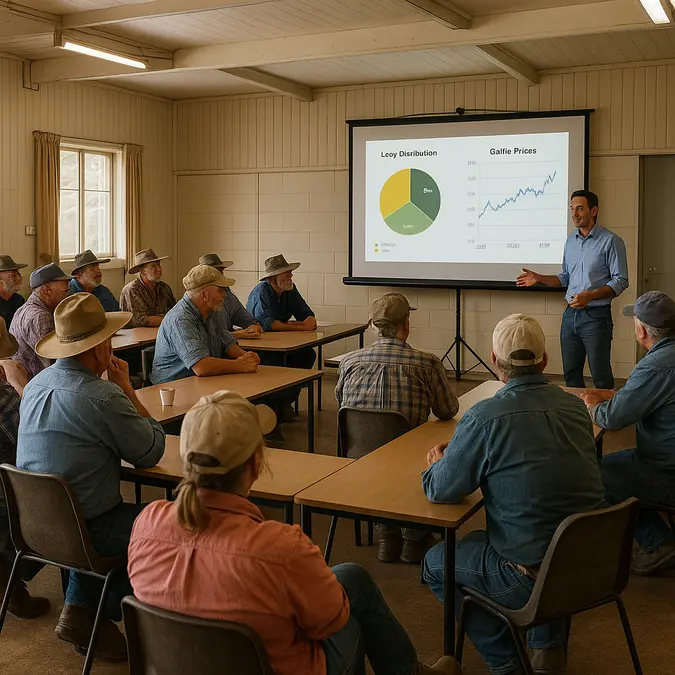
www.tnsmi-cmag.com – The national debate over how Australia funds grassfed beef industry services is converging on Western Australia, as Cattle Australia prepares to host two consultations focused on the cattle transaction levy and how producers want their money invested.
Cattle transaction levy: why WA consultations matter now
For many grassfed cattle producers, the cattle transaction levy is deducted almost invisibly at the point of sale. Yet this small, per-head charge underpins Australia’s marketing, research, animal health, biosecurity, and industry representation efforts. The upcoming Western Australian consultations by Cattle Australia mark a rare opportunity for producers to directly shape the future direction of that investment.
Contrary to the perception that levies are a fixed cost beyond producers’ control, the levy system is designed to be guided by industry priorities. When producers engage, funding can shift toward the projects and programs they believe deliver the highest return on investment – from export market access and traceability systems to climate resilience and feed efficiency research.
These WA meetings will not only gather feedback on whether the cattle transaction levy is set at the right level, but also on how it is allocated between marketing, research and development (R&D), animal health, and advocacy. In an environment of rising input costs, volatile global markets, and growing scrutiny of livestock emissions, every cent of levy spending is under pressure to prove its value.
How the cattle transaction levy works in Australia
To understand why these consultations matter, readers first need clarity on how the levy system operates. Australia’s red meat and livestock levy framework is set out under national legislation and administered primarily through the Department of Agriculture, Fisheries and Forestry, in concert with industry service providers such as Meat & Livestock Australia (MLA), Animal Health Australia, and the National Residue Survey.
Each time an eligible cattle transaction occurs – typically when cattle are sold through saleyards, direct to processors, or via private treaty – a fixed levy is collected per head. That money is then pooled nationally and allocated to specific purposes, often including:
- Marketing and market development – domestic and export promotion of Australian beef, brand campaigns, and trade missions.
- Research, development, and extension (RD&E) – productivity, genetics, animal welfare, methane reduction, pasture management, and feed efficiency.
- Animal health and biosecurity – surveillance, emergency disease preparedness, and residue monitoring.
- Industry representation – policy development and advocacy through recognized national bodies.
According to public data from sources such as Australia’s Department of Agriculture and Meat & Livestock Australia, the volume of funds generated through the cattle transaction levy each year runs into the tens of millions of dollars. That scale explains why consultations on levy priorities are not mere formality but central to the strategic direction of the red meat sector.
Why WA grassfed cattle producers are under the spotlight
Western Australia’s beef and cattle industry occupies a unique position in the national landscape. It combines vast, extensive pastoral operations in the north with more intensive, mixed-farming and finishing enterprises in the south. Many operations are heavily export-oriented, particularly into Asian markets and the Middle East, and must navigate long supply chains and specific market specifications.
As a result, WA producers may have distinct priorities for the cattle transaction levy compared with their counterparts in eastern Australia. For example, they may place stronger emphasis on:
- Improved live export market assurance and logistics planning.
- Infrastructure and supply chain efficiency from remote pastoral regions to ports.
- Pasture and rangeland management suited to arid and semi-arid environments.
- Biosecurity and disease prevention across very large properties and borders.
- Climate variability and drought preparedness tailored to WA conditions.
Cattle Australia’s decision to host targeted consultations in WA indicates recognition that a one-size-fits-all national strategy may miss regional nuances. When WA producers articulate where they see the highest returns on levy investment – whether in marketing, R&D, climate resilience, or traceability – it helps rebalance national programs to reflect on-ground realities.
For ongoing coverage of agricultural policy debates, readers can explore related analysis in our Politik section, which regularly examines how policy and funding decisions shape real-world business outcomes.
7 critical insights producers should bring to levy consultations
To move beyond surface-level feedback, producers attending the WA consultations on the cattle transaction levy can prepare by thinking through seven core issues. Each touches on how the levy delivers value and where gaps may exist.
1. Is the current levy level still fit for purpose?
The first and most contentious question is whether the levy is too high, too low, or about right. Input costs, interest rates, and land values have all increased sharply in recent years. Many producers feel squeezed and naturally scrutinize any statutory charge. At the same time, market access, disease preparedness, and global brand positioning require sustained investment.
Producers should ask themselves:
- Do current levy-funded programs generate measurable returns in sale prices, productivity, or risk reduction?
- If the levy were reduced, which programs would they be prepared to see scaled back?
- Conversely, if more investment is needed in specific areas (for example, climate adaptation or digital traceability), should that be funded through the existing levy, reallocation, or additional contributions?
2. Marketing versus R&D: how to balance the investment?
Historically, debates inside the beef sector often center on whether too much of the cattle transaction levy flows into marketing and not enough into long-term productivity research, or vice versa. WA producers should assess which side of that equation most strongly influences their businesses.
For heavily export-oriented enterprises, continued investment in brand Australia and market diversification may be paramount. For breeders and grassfed producers contending with variable seasons, genetics, feed efficiency, and pasture resilience R&D may offer greater long-term payoffs. The consultations offer a concrete opportunity to say, in clear terms, which side of the ledger should grow or shrink.
3. Climate resilience and emissions: are levy funds keeping pace?
Global pressure on livestock emissions and climate impacts is increasing. International agreements and consumer expectations are pushing beef supply chains to demonstrate lower emissions intensity and more sustainable production. Major reference points such as the Paris Agreement frame the debate, and trade partners are now factoring climate credentials into market access.
Levy-funded R&D already supports projects on methane reduction technologies, improved pasture species, and more efficient genetics. The question for WA producers is whether those programs are moving fast enough and whether they address the environmental realities of extensive rangeland systems. In regions where rainfall is variable and pasture growth is inconsistent, stand-alone technologies may be less effective than integrated landscape management research tailored to WA conditions.
4. Biosecurity and traceability: lessons from global disease outbreaks
Recent global disease events, from African swine fever to foot-and-mouth disease incursions in neighboring countries, have underscored how vulnerable livestock-dependent economies can be. Australia has, so far, maintained strong disease-free status, but the risk remains real and ever-present.
The cattle transaction levy contributes to biosecurity programs, traceability systems, and surveillance through recognized national bodies. Producers in WA, particularly those close to ports or with cross-border movement of stock, should evaluate whether these programs are adequately resourced and effectively implemented. Gaps in property identification, movement recording, or emergency response capacity can carry disproportionate risk in a state with long distances and sparse infrastructure.
5. Industry representation and advocacy: does the structure work?
Cattle Australia, as a peak body, plays a central role in representing grassfed producers at the national policy table. Levy funds may indirectly support this role through service agreements and governance structures. The WA consultations therefore double as an opportunity for producers to express views on how well they feel represented.
Strong representation requires both a clear mandate and active engagement from those who pay the bills. Without producer input, any advocacy body risks drifting away from grassroots priorities.
Producers should consider:
- Do current consultative mechanisms reach regional WA effectively?
- Are levy payers kept informed, in plain language, about how decisions are made?
- Is there enough transparency around how levy-funded outcomes translate into policy wins or avoided regulatory burdens?
6. Transparency, reporting, and measurable outcomes
A frequent criticism of statutory levies, across agriculture, is that producers see the deduction on sale documents but struggle to track how that money translates into tangible benefits. Modern governance standards demand more than high-level activity reporting; they require clear, measurable outcomes.
At the WA consultations, participants can push for:
- Regular regional reporting on levy-funded projects and their impact.
- Independent evaluation of major programs, especially in R&D and marketing.
- Simplified communication tools – dashboards, regional summaries, or case studies – that bridge the gap between national strategy and paddock results.
Some industry groups have already experimented with outcome-focused scorecards, borrowing from best practice in corporate reporting. Levy payers can explicitly request that the cattle transaction levy system moves further in this direction.
7. Regional equity: is WA getting its fair share?
Because the levy is pooled nationally, there is always a risk that the majority of funds are deployed where political weight or population density is greatest – typically in eastern states. WA producers often ask whether they receive a fair share of levy-funded services in proportion to the contributions they make and the distinct challenges they face.
The consultations give WA producers a structured forum to articulate this concern and, importantly, to suggest solutions. These might include:
- Minimum regional investment benchmarks for particular program areas.
- Dedicated WA-focused R&D portfolios.
- Regional advisory committees with clear influence over funding priorities.
Ensuring equitable distribution of cattle transaction levy benefits is not about fragmentation; it is about recognizing the diversity of Australia’s production systems and aligning national investment to that diversity.
How producers can prepare for the WA levy consultations
To make the most of the two planned WA sessions, producers should approach them as strategic business engagements rather than routine meetings. A few practical steps can amplify their influence.
Cattle transaction levy priorities: building your own checklist
Before attending, producers can draft a simple checklist covering:
- The top three benefits they currently attribute to the cattle transaction levy (for example, market access, brand reputation, genetics research).
- The top three gaps they see between levy-funded services and their business needs.
- Any specific regional issues in WA that national programs appear to overlook.
- Questions they want answered about how levy decisions are made and reviewed.
Taking even half an hour to prepare this list will help producers articulate their views clearly and ensure they leave the consultation with concrete answers rather than general impressions.
Collaborating across the WA supply chain
Another productive approach is to coordinate input across different parts of the WA supply chain – breeders, backgrounders, finishers, live exporters, processors, and agents. While interests can diverge, areas of common ground often include strong market access, robust biosecurity, and efficient logistics. A united voice on these priorities can carry more weight in shaping the national use of the cattle transaction levy.
Industry groups, regional producer networks, and professional advisers can assist in synthesizing feedback. For broader sector insights and commentary on market signals, readers can follow our reporting in Ekonomi, where we analyse how policy and levies intersect with profitability.
Demanding follow-through and feedback loops
Consultations only deliver value if they lead to clear action and transparent reporting. Producers attending the WA sessions can set the tone by asking for:
- Publication of a summary of feedback, broken down by region and theme.
- A timeline for any proposed changes to levy allocation or governance.
- Regular updates showing how WA-specific concerns are being addressed.
By framing these expectations at the outset, levy payers help ensure that consultation does not end with a meeting but becomes an ongoing dialogue.
The strategic stakes for Australia’s beef competitiveness
Beyond the immediate WA context, the direction of the cattle transaction levy has profound implications for Australia’s global beef competitiveness. Key competitors such as Brazil, the United States, and emerging suppliers are also investing heavily in genetics, branding, and logistics. At the same time, trade partners are tightening requirements on traceability, welfare, and sustainability.
Australia cannot afford to underinvest in the systems that differentiate its beef as safe, clean, and responsibly produced. Nor can it ignore the financial pressure on producers. The levy conversation, therefore, is fundamentally about calibrating the balance between short-term cost and long-term competitiveness.
Western Australia’s voice will be especially important in areas such as:
- Maintaining and diversifying export markets in Asia and the Middle East.
- Developing shipping, port, and cold chain solutions suited to long distances.
- Pioneering rangeland management and climate adaptation strategies for extensive systems.
Levy investment, guided by robust WA input, can help position the state not as a peripheral contributor but as an innovation leader within Australia’s beef sector.
Conclusion: why every WA producer’s voice counts
As Cattle Australia convenes two critical Western Australian consultations, grassfed producers face a clear choice: treat the cattle transaction levy as a fixed, unavoidable tax, or engage with it as a strategic investment instrument they can shape. The second path demands time, preparation, and a willingness to argue for priorities grounded in real business experience. But it is the only approach that promises a levy system aligned with WA’s unique production conditions, market pathways, and climate realities.
If producers across the state use these consultations to articulate clear preferences on levy levels, marketing versus R&D balance, climate resilience, biosecurity, representation, transparency, and regional equity, they can help reorient national programs toward outcomes that genuinely strengthen their businesses. In doing so, they will not only influence how millions of dollars are spent each year but also help secure Western Australia’s position within a globally competitive, resilient Australian beef industry built on a smarter, more accountable cattle transaction levy.