
 0
0
 0
0
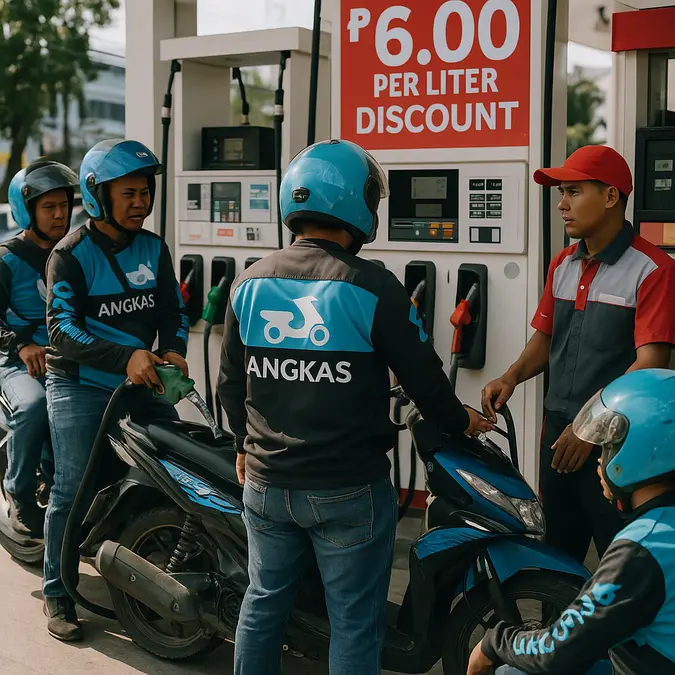
www.tnsmi-cmag.com – Cebu fuel discounts have taken center stage after Top Line Business Development Corp., through its retail unit Light Fuels Corp., sealed a strategic partnership with motorcycle ride-hailing platform Angkas to give Cebu riders exclusive fuel savings and service benefits amid rising oil prices.
Cebu fuel discounts and the Top Line–Angkas partnership explained
The new agreement between Cebu-based listed firm Top Line Business Development Corp. and Angkas comes at a time when global oil markets remain volatile and pump prices in the Philippines continue to climb. Light Fuels Corp., the retail fuel arm of Top Line, will now offer exclusive Cebu fuel discounts and perks to accredited Angkas riders operating within Cebu province.
According to Top Line’s disclosure to the Philippine Stock Exchange, the collaboration allows Light Fuels to tap roughly one-third of Cebu’s motorcycle taxi market. The province’s motorcycle taxi technical working group (TWG) caps the total number of riders at 9,000 across three accredited operators, making access to this high-frequency segment a critical win for any fuel retailer.
Top Line projects that the deal could unlock up to 42,000 liters of additional liquid fuel sales per day across Light Fuels’ network. For investors and industry observers, those numbers signal not just incremental revenue, but also deeper integration into Cebu’s mobility ecosystem.
How Cebu fuel discounts work for Angkas riders
Under the agreement, Angkas riders in Cebu will be enrolled in the Light Rewards Suki Program, Light Fuels’ customer loyalty and rewards scheme. Through this program, riders can access structured Cebu fuel discounts and value-added services that improve their daily economics on the road.
- Gasoline discount: ₱2 per liter
- Diesel discount: ₱1 per liter
- Service perks: one complimentary motor wash per quarter
- Promotions: eligibility for Light Fuels’ grand raffle and other marketing campaigns
For Angkas riders, who operate as high-frequency fuel consumers, these discounts can compound meaningfully. A rider who consumes 8–10 liters of gasoline per day could see daily savings of ₱16–₱20, translating into hundreds of pesos each month. At scale, across thousands of riders, the aggregate reduction in fuel expenditure becomes a substantial support mechanism for the entire fleet.
Angkas head of operations David Brian Medrana emphasized this point, noting that fuel remains “one of the biggest recurring expenses” for motorcycle taxi riders. Any consistent discount, even if seemingly modest on a per-liter basis, directly boosts take-home income or allows riders to manage inflationary pressures on other costs, from maintenance to personal living expenses.
Cebu fuel discounts as a volume and loyalty strategy for Light Fuels
From the perspective of Top Line and Light Fuels, the deal is a classic volume and loyalty play. Rather than chasing one-time retail sales, the company is securing steady, repeat fuel purchases from a well-defined user group that refuels frequently by nature of their work.
Eugene Erik Lim, chairman, president and CEO of Top Line, underscored that the agreement not only aims to unlock up to 42,000 liters of daily fuel sales, but also positions Light Fuels as a preferred partner for high-frequency road users. In practice, this means more predictable foot traffic at station forecourts, stronger brand recognition among everyday motorists, and the opportunity to cross-sell ancillary services and products.
Light Fuels’ integration of its loyalty program into the partnership is particularly significant. Rewards ecosystems often serve as a strategic moat: once riders are enrolled, actively earning and redeeming benefits, the switching costs—both psychological and economic—rise. Rivals must offer materially better terms or convenience to pull riders away.
This strategy mirrors global best practices in the fuel retail industry. Major international players, such as Shell and BP, have long leveraged rewards schemes to deepen engagement among commercial fleets and ride-hailing drivers. The Cebu initiative suggests that Light Fuels is adopting similar customer lifetime value thinking, adapted to local market conditions and regulatory frameworks.
Why Cebu fuel discounts matter in a volatile oil market
The timing of these Cebu fuel discounts is not accidental. Philippine fuel prices are heavily influenced by global crude benchmarks, currency movements, and local tax structures. With oil markets facing persistent uncertainty—driven by geopolitical tensions, production cuts, and shifting demand patterns—transport operators and gig-economy workers sit on the front lines of price spikes.
According to data from the global oil price history and regional monitoring, even modest weekly adjustments can erode margins for transport workers. When pump prices climb faster than fare adjustments, riders absorb the difference. Fuel discount schemes therefore operate as a private-sector buffer against shocks that public regulators cannot always offset in real time.
In this context, the Top Line–Angkas partnership can be read as an adaptive response by both a fuel retailer and a mobility platform to protect their most critical asset: their rider base. Angkas retains a more financially resilient fleet, better able to operate full shifts and maintain service coverage. Light Fuels, for its part, sustains or grows its throughput volumes even when discretionary driving by ordinary motorists declines.
Cebu fuel discounts and the evolution of the motorcycle taxi market
The Cebu motorcycle taxi market operates under a relatively strict regulatory environment. The provincial motorcycle taxi TWG maintains a 9,000-rider cap across three accredited operators, including Angkas. This cap effectively defines the addressable professional motorcycle taxi segment and shapes competition among platforms for both riders and passengers.
By partnering with Angkas and tying Cebu fuel discounts directly to active riders, Light Fuels effectively embeds itself into a core part of Cebu’s transport infrastructure. As long as Angkas maintains or grows its share of the 9,000-rider quota, Light Fuels accesses a reliable fuel consumption base.
The partnership also reflects a deeper trend in the mobility sector: the convergence of platforms, infrastructure providers, and financial or loyalty systems. Just as ride-hailing companies globally collaborate with banks or digital wallets to offer driver incentives, Cebu’s motorcycle taxi ecosystem is seeing fuel and mobility interests align around shared economic value.
For readers tracking regional mobility innovation, this development sits alongside other experiments in Southeast Asia, such as incentive programs by Grab or Gojek for their driver-partners, often anchored around fuel, insurance, and maintenance benefits. A report from Reuters on Asian mobility platforms has repeatedly highlighted how driver economics and loyalty programs shape competitive advantage in crowded urban markets.
Cebu fuel discounts: implications for investors and local economies
From an investment perspective, the Top Line–Angkas agreement offers several important signals about the direction of Cebu’s local economy and the fuel retail segment:
- Volume consolidation: By securing high-frequency buyers, Light Fuels may reinforce its station-level economics even if broader discretionary demand fluctuates.
- Network optimization: Data on Angkas rider fueling patterns can guide future site selection, helping Top Line decide where to expand its retail footprint.
- Brand positioning: Aligning with a widely recognized mobility platform strengthens Light Fuels’ brand equity among both riders and passengers.
- Economic resilience: Supporting rider incomes indirectly stabilizes Cebu’s broader services economy by keeping mobility services reliable and affordable.
Lim has framed the strategy as part of a broader ambition to expand Top Line’s presence in key economic hubs across the Visayas. Cebu, with its growing urban centers, tourism corridor, and logistics activity, represents a natural anchor for such an expansion.
Mobility, fuel, and economic development are closely intertwined. Reliable and affordable transport allows workers to reach jobs, businesses to distribute goods, and tourists to access destinations. By sharing some of the burden of fuel volatility via Cebu fuel discounts, private firms can play a material role in sustaining local economic momentum.
For more context on how infrastructure and mobility shape regional growth, readers can explore our coverage under tags such as Business and Transport, where we routinely track how corporate strategies intersect with public policy and everyday consumer experience.
Cebu fuel discounts within the competitive fuel retail landscape
Competition in the Philippine fuel market spans major international oil companies, large domestic chains, and a growing ecosystem of independent and regional players. In this environment, differentiation increasingly depends on more than just headline pump prices.
The Top Line–Angkas initiative illustrates one such differentiator: targeted, partnership-driven Cebu fuel discounts paired with non-price benefits like loyalty rewards, raffles, and service add-ons. For riders weighing where to refuel, the cumulative value proposition of a network—convenient locations, consistent discounts, simple digital enrollment, and meaningful perks—may outweigh small price differentials between brands.
Additionally, the data derived from such partnerships can become a strategic asset. Understanding peak fueling times, popular corridors, and average spend per rider can guide everything from station staffing to inventory planning. Over time, this analytics-driven approach can improve margins and inform negotiations in other business lines, such as commercial supply agreements or co-branded campaigns.
Operational realities: how riders may experience Cebu fuel discounts day-to-day
For Angkas riders on the ground, the impact of the agreement will depend on how seamlessly the program integrates into their daily routines. Key operational questions include:
- How quickly and easily can new riders enroll in the Light Rewards Suki Program?
- Is the discount automatically applied at the point of sale when they refuel?
- Can riders track their savings and rewards digitally, or is the system card-based?
- Are Light Fuels stations located along common Angkas routes and high-demand passenger corridors?
If these touchpoints are well-designed and responsive to rider feedback, the perceived value of Cebu fuel discounts will remain high. Conversely, friction in enrollment, redemption, or station access could dilute the theoretical benefits and reduce uptake.
Top Line’s public messaging suggests a focus on accessibility and everyday relevance, with Lim noting the intent for Light Fuels to be “present in the daily journeys of riders, drivers, businesses, and communities that keep the local economy moving.” Translating that ambition into operational reality will likely require close coordination between Light Fuels’ retail teams and Angkas’ local operations staff.
What Cebu fuel discounts signal about the future of mobility partnerships
Beyond the immediate economics, the Top Line–Angkas partnership hints at how future mobility ecosystems may evolve in Philippine cities. As regulators refine motorcycle taxi rules, and as cities contend with congestion and environmental pressures, integrated solutions that tie together fuel, transport platforms, and consumer incentives may become more common.
We could see similar partnerships emerge in other regions, or even multi-party collaborations involving financial services providers, insurance firms, and maintenance networks. Riders might, for example, earn fuel points that convert into micro-insurance coverage, or benefit from discounted maintenance packages tied to their loyalty status. Each of these layers would be designed to stabilize driver income, improve safety, and lock in loyalty to participating brands.
At the same time, policymakers will watch these trends closely. While private-sector-driven Cebu fuel discounts can complement public transport and regulatory objectives, transparency and fairness will remain crucial. Ensuring that benefits reach riders equitably, that pricing remains competitive, and that data is handled responsibly will be essential to maintaining trust among all stakeholders.
For readers who want to follow the broader policy backdrop to such partnerships, our ongoing analyses on Business and Transport explore how corporate strategies intersect with regulation and consumer welfare in key Philippine markets.
Conclusion: Cebu fuel discounts as a blueprint for rider-centric growth
The Top Line–Angkas collaboration offers a compelling case study in how targeted Cebu fuel discounts can simultaneously serve riders, fuel retailers, and the wider local economy. Riders gain tangible savings on one of their largest recurring expenses, improving financial resilience in the face of volatile oil prices. Light Fuels secures stable, high-frequency demand and deepens customer loyalty through its rewards ecosystem. Cebu’s mobility network benefits from a more supported, and potentially more stable, rider base.
As fuel costs and economic uncertainties persist, this partnership may well serve as a blueprint for other regional markets and industry players. If executed effectively, Cebu fuel discounts will not only ease the daily strain on thousands of motorcycle taxi riders, but also illustrate how collaborative, incentive-based models can drive sustainable growth in the transport and energy sectors.