
 0
0
 0
0
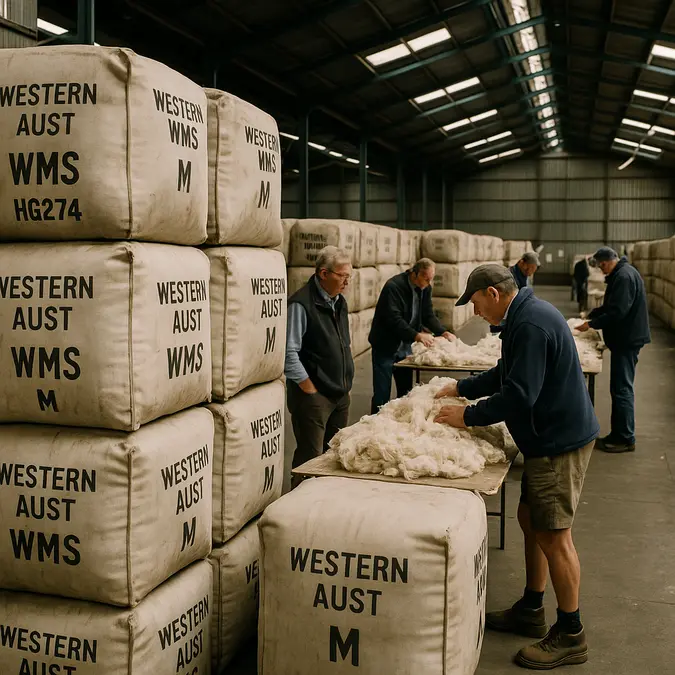
www.tnsmi-cmag.com – The WA wool market is entering one of its most closely watched phases in years, with leading Western Australian brokers and analysts predicting that prices will remain firm over the next six to 12 months despite a rocky start to the season and high pass-in rates at recent auctions.
WA wool market outlook: supply squeeze, price resilience and changing seller sentiment
Western Australia sits at the heart of Australia's global wool reputation, and the WA wool market often acts as a barometer for fine and medium wool sentiment worldwide. According to regional experts quoted in local industry reports, a convergence of tight supply, improving global demand and increasingly pragmatic selling strategies is likely to underpin a stronger, more stable market through the first half of 2025.
Over recent months, many growers have resisted selling at auction, passing in significant volumes in the hope that prices will rebound from early-season weakness. That caution is understandable. The Eastern Market Indicator (EMI), the Australian benchmark tracked by the Australian Wool Exchange (AWEX), has experienced sharp week-to-week volatility, and WA sale rosters have not been immune.
However, as experts now point out, the structural story is turning in favour of sellers: the national flock is still rebuilding after drought, shearing numbers remain constrained, and processors are beginning to compete more aggressively for reliable, well-prepared clips. As this reality sinks in, resistance to sell is expected to ease, auction clearance rates should improve, and pass-in rates are likely to trend lower.
WA wool market fundamentals: why low supply is a powerful price driver
To understand the likely trajectory of the WA wool market over the next six to 12 months, readers must start with the fundamentals: supply, demand and stock levels.
WA wool market and the national flock rebuild
Australia is still working its way through the long tail of drought and flock liquidation. According to national statistics from Australia's Department of Agriculture, sheep numbers have been rebuilding but remain significantly below their multi-decade averages. In WA, this is particularly acute: sheep producers who diversified into crops or exited livestock during tougher years have not all returned to full-scale wool production, leaving fewer bales available for market.
This structural tightness is central to current price strength. In any commodity market, when supply remains constrained while demand holds steady or improves, prices tend to firm. The WA wool market is no exception. Fewer sheep means fewer fleeces, and fewer fleeces mean a shorter auction catalogue each week. Export buyers who need to fill forward contracts for mills in China, India and Europe must compete harder for limited offerings, particularly for well-classed, low-vegetable-matter wool.
Stock levels and on-farm holding strategies
While total production is one part of the equation, the other is how much wool growers choose to hold back. Through late 2024 and into early 2025, many WA growers responded to weaker sale weeks by passing in bales and storing them on farm or with brokers. This strategy effectively tightened available supply even further at auction, but it created a backlog of stock that will eventually need to be sold.
Industry experts now argue that most of the "easy" holding decisions have been made. As shearing cycles continue and cashflow timelines approach, growers will gradually release more of those held bales into the system. However, because overall supply remains tight, this return of held stocks is unlikely to flood the market. Instead, we are likely to see a more orderly flow of wool onto the auction floor, which can support a firmer and more stable price pattern.
Global demand signals: how overseas mills are shaping the WA wool market
Beyond local production, the WA wool market is highly sensitive to international economic conditions. Wool is a classic globally traded commodity: what happens in Chinese textile hubs, European fashion houses or US retail chains eventually filters down into prices in Fremantle and other Australian auction centres.
China's role in the WA wool market
China remains the dominant buyer of Australian wool. Any meaningful shift in Chinese purchasing behaviour resonates throughout the WA wool pipeline. Despite concerns over economic slowdowns and property sector weakness, Chinese mills still rely on high-quality Australian wool for both traditional suiting fabrics and newer, performance-oriented textiles.
Evidence from recent sale reports, industry briefings and trade data suggests that Chinese topmakers and spinners are cautiously rebuilding inventories after running them lean through periods of uncertainty. This restocking, while not explosive, is enough to underpin a base level of demand that supports prices, particularly in fine and medium Merino categories commonly produced in WA.
Diversification into Europe, India and premium segments
Another encouraging sign for the WA wool market is the gradual diversification of demand. European fashion brands and manufacturers continue to emphasise sustainability and natural fibres, with wool featuring heavily in premium garments, outerwear and luxury knitwear. Meanwhile, India's emerging role as a processing and consumption hub offers additional demand pathways, especially for specific micron ranges.
These developments align with broader sustainability trends covered regularly on Environment and innovation themes on Technology within our magazine. Wool's renewable, biodegradable attributes resonate strongly with consumers looking beyond synthetics, helping to insulate the market from some of the cyclical downturns that have historically shadowed the fibre.
Why pass-in rates are likely to fall in the WA wool market
High pass-in rates have been a defining feature of recent WA auctions. Many growers have preferred to withhold bales rather than accept what they perceive as discounted prices. However, as more information about supply and demand becomes visible and as price levels stabilise, those pass-in rates are widely expected to fall.
Shifting grower psychology and price anchoring
For much of the past decade, growers became accustomed to relatively high wool prices, particularly during the pre-pandemic peaks when strong Chinese demand and limited supply coincided. That experience set a "mental anchor" for what many producers now consider a fair price per kilogram.
When the market corrected lower in 2023–2024, this anchor made it difficult for some sellers to recalibrate expectations. Passing in wool felt like the rational choice if the offers on the day failed to match those prior highs. Over time, however, new reference points emerge. As growers observe that the WA wool market is not collapsing but rather consolidating, they adjust expectations toward the new price reality and become more willing to meet the market.
Cashflow, storage costs and risk management
There are also practical limits to how long wool can be held back. Storage costs, insurance and the opportunity cost of tied-up capital all erode the benefits of waiting indefinitely. Furthermore, price risk cuts both ways; while many growers hope for higher levels later in the season, there is always the possibility of macroeconomic shocks, currency moves or demand setbacks reducing prices instead.
Industry advisers are increasingly encouraging a balanced approach: sell a portion of production at current levels to secure cashflow, while retaining some flexibility to capture potential upside later. This more diversified marketing strategy tends to reduce extreme pass-in behaviour and supports smoother auction clearance in the WA wool market.
Quality differentials: how preparation and micron shape outcomes in the WA wool market
Another critical layer in the outlook is quality. Not all wool is rewarded equally, and in a tight but selective market, preparation, classing and objective measurement make a significant difference to final returns.
Premiums for well-prepared WA wool
Export buyers have consistently demonstrated a willingness to pay premiums for well-classed, low-contamination wool that fits strict specifications. In WA, where many enterprises combine cropping and livestock, attention to shed preparation and clip presentation can sometimes vary. However, as prices for top-quality lines outperform the broader indicators, more growers are investing in best-practice shearing and classing standards.
This shift enhances the overall reputation of the WA wool market and can attract additional competition from overseas mills seeking reliable, repeatable product. For readers, the message is clear: in a world of constrained supply, quality becomes an even more powerful differentiator.
Micron spread and market segmentation
Price behaviour also differs across micron categories. Fine Merino wools continue to enjoy robust demand in luxury apparel and performance wear, while broader crossbred wools can face steeper competition from synthetic fibres. WA production is skewed toward certain Merino micron ranges, which has, historically, been an advantage when global fashion trends favour finer, softer fabrics.
As long as consumer preferences continue to migrate toward comfort, performance and sustainability, these micron segments should maintain solid support within the WA wool market, particularly when coupled with strong provenance and environmental credentials.
Risk factors that could still unsettle the WA wool market
Although the consensus view among experts is moderately optimistic, professionals and investors should remain conscious of several risk factors that could destabilise the WA wool market.
- Global economic slowdown: A sharper-than-expected downturn in major economies could dent discretionary spending on apparel, including wool garments.
- Currency volatility: A sustained appreciation of the Australian dollar against key currencies could make Australian wool less competitive overseas.
- Geopolitical tensions and trade policy: Tariffs, sanctions or logistical disruptions can quickly alter trade flows and buyer behaviour.
- Climate and production shocks: Adverse seasonal conditions could either further restrict supply or, in some regions, push more wool into the market unexpectedly if growers are forced to offload stock.
These risks do not negate the positive structural story, but they reinforce the importance of flexible marketing strategies and strong risk management for anyone exposed to the WA wool market.
Strategic takeaways: positioning for the next six to 12 months in the WA wool market
For readers in production, finance, logistics or textile manufacturing, the immediate question is how to use this outlook in practical decision-making. Aligning strategy with the likely evolution of the WA wool market can unlock real value.
For growers and brokers
"In a structurally tight supply environment, disciplined selling beats speculative holding" – a sentiment now echoed by many WA brokers.
- Review cashflow needs and adopt a staged selling program rather than an all-or-nothing approach.
- Invest in clip preparation, classing and objective measurement to access premiums for quality.
- Stay informed via trusted market reports and independent analysis rather than relying solely on anecdotal price stories.
For processors and buyers
- Secure forward supply arrangements with reliable WA growers to mitigate the impact of tight catalogues.
- Experiment with value-added products that leverage wool's natural performance attributes, including moisture management and temperature regulation, which are increasingly highlighted by global media such as Wikipedia's wool overview.
- Monitor fashion and retail trends to anticipate shifts in micron demand and colour preferences.
Conclusion: why the WA wool market is poised for a firm, disciplined phase
The evidence from brokers, sale reports and global demand indicators converges on a common theme: the WA wool market is unlikely to revisit the deepest lows of recent years, nor is it set for an unchecked speculative boom. Instead, we appear to be entering a more disciplined, fundamentally driven phase, defined by constrained supply, gradually normalising seller behaviour and steady, sustainability-focused demand from overseas mills and fashion brands.
For readers, that means opportunity – but also responsibility. Whether you are a grower deciding when to sell, a buyer planning procurement, or a stakeholder watching signals from Western Australia to guide broader investment decisions, the next six to 12 months will reward those who marry data-driven insight with practical, on-the-ground experience. By understanding how low supply, evolving pass-in rates and international consumer trends interact within the WA wool market, you can position yourself at the front of this critical shift rather than reacting from behind.