
 0
0
 0
0
www.tnsmi-cmag.com – Deep-tech startup Atomionics, backed by SG Growth Capital and already collaborating with Singapore’s Ministry of Defence (Mindef), has opened a new research hub that speaks volumes about where Singapore’s innovation economy is heading next.
The move is more than a routine expansion. It illustrates how quantum and deep-tech ventures are shifting from theoretical research into real-world dual-use applications, serving both commercial markets and national defence needs. For readers tracking the intersection of frontier technology, state strategy, and private capital, Atomionics’ latest step offers a revealing case study.
Deep-tech startup Atomionics and the Rise of Dual-use Innovation
Deep-tech startup Atomionics sits squarely at the confluence of three powerful trends: the maturation of quantum-adjacent sensing technologies, the surge of mission-driven capital into deep tech, and governments’ growing appetite for dual-use capabilities. While full deal terms remain private, the startup’s backing by SG Growth Capital and its ongoing partnership with Mindef are strong signals of confidence in both its technology and its strategic relevance.
In many advanced economies, defence agencies increasingly turn to startup ecosystems to access innovation cycles that move faster than traditional procurement. This model, pioneered in the United States by entities such as the Defense Advanced Research Projects Agency (DARPA), is now inspiring similar innovation pathways around the world, including Singapore.
Atomionics’ new research hub, therefore, is not merely an internal milestone. It marks a concrete investment in capabilities that can be spun out into both civilian and defence applications—an evolution that will matter to decision makers in industry, government, and finance alike.
Why the New Research Hub Matters for Singapore’s Deep-tech Ambitions
Singapore has spent years positioning itself as a global node for high-value research and innovation. From generous R&D tax incentives to world-class universities, the city-state has systematically built an enabling environment for deep-tech ventures. The launch of a dedicated research hub by deep-tech startup Atomionics shows how these policies are starting to crystallize into tangible industrial capabilities.
Several strategic dimensions stand out:
- Concentration of talent: A dedicated hub allows Atomionics to cluster physicists, engineers, data scientists, and product specialists in one place, shortening feedback loops between research, prototyping, and field testing.
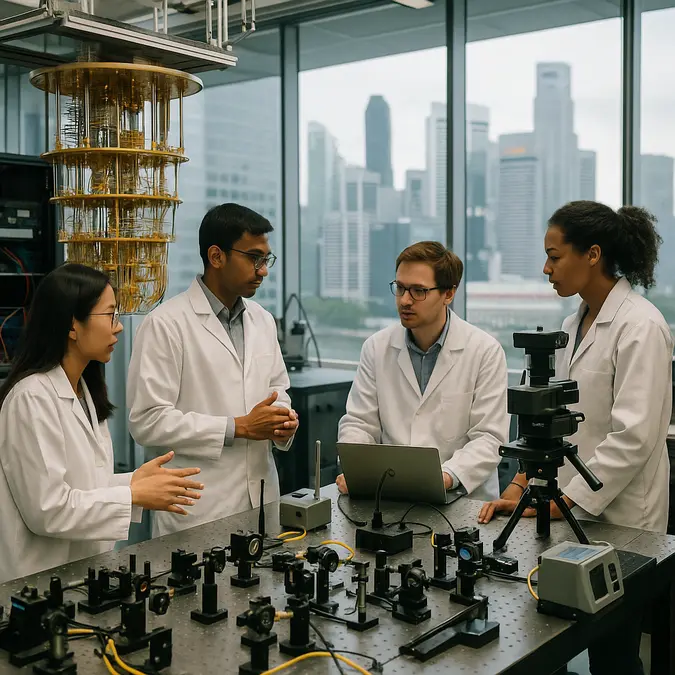
- Hardware-heavy experimentation: Unlike software startups, deep-tech ventures need lab infrastructure, specialized equipment, and strict environmental controls. A research hub anchors these capabilities locally.
- Proximity to end users: Being embedded in Singapore’s ecosystem—close to ports, critical infrastructure, and defence stakeholders—enables rapid iteration on real-world use cases.
According to public data from Enterprise Singapore and related agencies, the country has seen a measurable rise in venture capital flowing into deep-tech deals across sectors such as robotics, advanced manufacturing, and quantum technologies. Global research from PwC and other analysts paints a similar picture: investors now seek technology with high defensibility and long-term strategic relevance, rather than purely growth-at-all-costs digital models.
Atomionics’ expansion aligns squarely with this shift, underscoring how deep-tech infrastructure is increasingly seen as a national asset rather than a niche experiment.
Deep-tech startup Atomionics: Inside the Dual-use Strategy with Mindef
The partnership between deep-tech startup Atomionics and Mindef highlights a critical trend: the convergence of commercial and defence technology roadmaps. Dual-use technologies—those that can serve both civilian and military purposes—have long played a role in innovation, from GPS (initially a military project) to the internet itself, as documented extensively by sources like Wikipedia.
Atomionics’ dual-use orientation follows this lineage. While specific project details remain confidential for security and competitive reasons, we can infer several potential application domains based on global deep-tech trajectories:
- Navigation and positioning: Quantum-inspired inertial sensors can offer precise navigation without reliance on GPS signals—valuable in contested environments or critical infrastructure settings.
- Subsurface and structural sensing: Advanced gravimetric or seismic sensing can help in mapping underground structures, supporting both resource industries and defence planning.
- Resilient infrastructure monitoring: High-sensitivity sensors may allow real-time monitoring of bridges, tunnels, or ports, enhancing national resilience while opening commercial markets in construction and logistics.
For Mindef, partnering with an agile deep-tech startup like Atomionics potentially lowers the cost and time to access advanced capabilities compared with developing everything in-house. For Atomionics, defence engagement offers demanding test environments, long-term project visibility, and validation that can de-risk its technology for global commercial customers.
How Deep-tech startup Atomionics Balances Commercial and Defence Needs
Balancing civilian and defence applications is not trivial. It demands careful attention to export controls, ethical considerations, and intellectual property management. Deep-tech startup Atomionics is navigating a landscape in which governments insist on strategic autonomy, while investors seek scalable global markets.
To perform well in this environment, a company must:
- Segment its product portfolio clearly between civilian and defence use cases.
- Design compliance processes to meet security and export regulations.
- Build governance structures that reassure both government partners and commercial clients.
Readers who follow Technology policy will recognize these as recurring themes in debates around semiconductors, AI, and satellite systems. Atomionics’ approach—developing a strong local research footprint while engaging directly with Mindef—offers one blueprint for how a deep-tech player can engage with these competing pressures.
Investor Confidence: SG Growth Capital and the Deep-tech Thesis
The backing of deep-tech startup Atomionics by SG Growth Capital adds another layer of significance. While the financial details are not public, the participation of a growth-oriented investor sends several important signals:
- Validation of technical feasibility: Deep-tech investors tend to conduct extensive due diligence on scientific risk. Their presence often signals that the underlying physics and engineering have crossed a key validation threshold.
- Longer time horizons: Deep-tech generally requires more patient capital than pure software. Growth investors willing to commit here show confidence in the medium- to long-term value of the technology.
- Strategic alignment with national priorities: For an investor operating in Singapore, supporting technology that aligns with national resilience and innovation agendas is often seen as both a commercial and civic contribution.
Globally, there has been a resurgence of interest in deep tech as short-cycle consumer applications become saturated. Reports from firms such as McKinsey have argued that deep tech can offer defensible moats and transformative economic impact, albeit with higher technical and execution risk.
By aligning with investors who understand these dynamics, Atomionics gains not only capital but also access to networks of partners, customers, and policymakers—an essential ingredient for any startup operating at the frontier of science and engineering.
What the Atomionics Hub Means for Singapore’s Innovation Ecosystem
The establishment of a new research hub by deep-tech startup Atomionics has implications far beyond a single company’s trajectory. It could influence how future founders, researchers, and investors evaluate Singapore as a base for deep-tech ventures.
Talent, Clusters, and Knowledge Spillovers
Innovation does not happen in isolation. As Atomionics grows its physical presence, it will inevitably interact with universities, research institutes, and other startups. These interactions often generate what economists call “knowledge spillovers”—informal exchanges of ideas, methods, and best practices that raise the overall capability of a region.
In practical terms, we can expect:
- More cross-appointments between industry and academia, as researchers seek to commercialize their findings.
- Shared infrastructure opportunities, where specialized equipment or lab facilities can be co-used or spun out.
- New career pathways for scientists and engineers who want to work at the interface of research and real-world impact.
Readers following the evolution of Startups in the region will recognize this pattern from other clusters, such as biomedical hubs or fintech sandboxes. Deep-tech startup Atomionics adds a new flavour to this mix, rooted in hardcore physics and advanced sensing technology.
Positioning Singapore in the Global Deep-tech Race
Singapore’s advantage in the global deep-tech race has historically rested on three pillars: political stability, reliable regulation, and world-class infrastructure. Yet these are necessary but not sufficient conditions. To compete with larger markets, the country must demonstrate that frontier technologies can be conceived, incubated, tested, and scaled from its shores.
Atomionics’ new hub supports this narrative in several ways:
- Signal to global partners: Multinationals and international research organizations see that Singapore hosts not only regional sales offices but also genuine frontier R&D.
- Proof of state–startup collaboration: The Mindef partnership shows that government agencies are open to working closely with emerging companies, not just large incumbents.
- Blueprint for future deep-tech ventures: From regulatory engagement to infrastructure provisions, Atomionics’ journey can inform policy refinements that make future deep-tech ventures easier to launch and scale.
Risks, Challenges, and the Road Ahead for Deep-tech startup Atomionics
Amid the optimism, it is important to recognize the challenges that deep-tech startup Atomionics—and peers in the sector—must navigate. Deep tech is inherently risky, and even well-capitalized, well-connected ventures can encounter setbacks.
Key challenges include:
- Technical uncertainty: Pushing the boundaries of physics and engineering means that unexpected bottlenecks can emerge in scalability, reliability, or cost.
- Market education: Potential customers, whether in logistics, energy, or defence, may not immediately grasp the value of novel sensing or navigation solutions. Sales cycles can be long.
- Regulatory complexity: Dual-use technologies must comply with export controls and national security rules. Missteps can cause delays or limit market access.
- Capital intensity: Hardware and lab-heavy R&D consumes more upfront capital than purely digital products, requiring disciplined financial management and milestone planning.
Yet it is precisely because of these challenges that Atomionics’ progress is noteworthy. By securing backing from SG Growth Capital and entering a structured partnership with Mindef, the company has built a foundation that can help buffer these risks. The new research hub gives it physical and organizational infrastructure to tackle complex multi-year problems with focus and rigor.
Deep tech is not about overnight disruption; it is about building the capabilities that societies will rely on for decades to come—across infrastructure, security, and economic competitiveness.
Conclusion: Deep-tech startup Atomionics as a Strategic Test Case
Deep-tech startup Atomionics has moved from being a promising name in Singapore’s research landscape to a concrete operator with a dedicated research hub, institutional backing, and a high-stakes defence partnership. For policymakers, it offers a test case of how state agencies can effectively harness startup agility for national priorities. For investors, it illustrates the contours of a credible deep-tech thesis anchored in dual-use applications. For founders and researchers, it signals that Singapore is willing to support ambitious, hardware-intensive innovation rather than restricting itself to lightweight digital plays.
As the company scales its new hub, the key questions will revolve around execution: how quickly Atomionics can translate cutting-edge sensing and navigation technologies into robust field deployments; how effectively it can balance commercial and defence requirements; and how it can contribute to a broader ecosystem in which deep-tech breakthroughs become a sustainable engine of economic value. However the details unfold, one conclusion is already clear: deep-tech startup Atomionics has become a critical reference point in understanding where Singapore’s innovation strategy—and its integration of technology, security, and commerce—is headed next.