
 0
0
 0
0
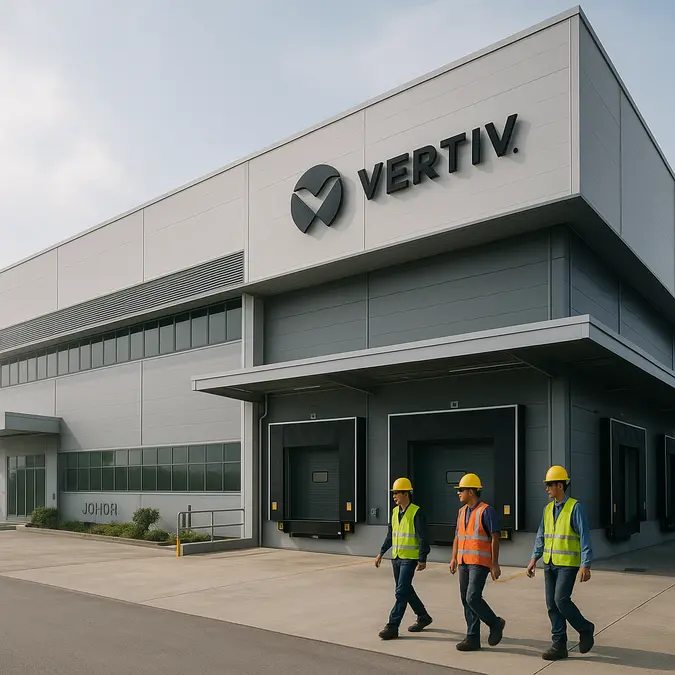
www.tnsmi-cmag.com – The opening of the new Vertiv Johor factory in Malaysia signals far more than another industrial ribbon-cutting; it marks a strategic escalation in the race to build the physical backbone for artificial intelligence, cloud, and high-density computing across Asia.
Located in Senai, Johor – one of Southeast Asia’s fastest-growing industrial hubs – Vertiv’s approximately 236,000-square-foot (21,900-square-meter) manufacturing facility is designed to support rapidly rising demand for AI-ready data center infrastructure in Southeast Asia, North Asia, Australia, and New Zealand. For regional operators, hyperscalers, and enterprises, this move potentially reshapes supply chains, technology choices, and competitive dynamics in the digital economy.
Vertiv Johor factory and the new geography of AI infrastructure
Vertiv is a global provider of critical digital infrastructure – from power and cooling systems to racks, enclosures, and modular data centers. As AI workloads accelerate, the industry is witnessing a new wave of infrastructure demand that is more power-intensive, thermally challenging, and latency-sensitive than traditional cloud applications. The Vertiv Johor factory directly targets this intersection of rising demand and shifting geography.
Asia-Pacific has become a growth engine for the global data center industry. According to multiple market research firms, the region’s data center market is expected to grow at a high single to double-digit compound annual growth rate over the next several years, powered by cloud adoption, e-commerce, 5G, and AI. Malaysia, in particular, has emerged as a competitive location, especially the Johor–Singapore corridor, which offers land and power advantages while sitting next door to one of the world’s most mature data center markets.
By anchoring a major manufacturing footprint in Johor, Vertiv is positioning itself physically closer to some of the world’s fastest-growing, AI-hungry markets while diversifying away from single-country production concentration. For regional buyers, this can translate into better lead times, localized product configurations, and greater resilience against supply chain shocks.
5 critical drivers behind the Vertiv Johor factory decision
To understand the significance of this facility, we need to break down the key forces behind it. The Vertiv Johor factory is not an isolated move; it reflects a broader realignment in technology, geopolitics, and sustainability.
Vertiv Johor factory and AI-driven high-density computing demand
AI infrastructure is fundamentally different from traditional enterprise IT. Training and inference for large language models and advanced analytics require massive clusters of GPUs or accelerators, each drawing significantly more power and generating more heat than conventional CPUs. According to public data center industry research, rack power densities in AI environments can reach 30–60 kW or more per rack, versus the 5–10 kW typical a decade ago.
This surge in density creates cascading challenges:
- Power infrastructure: Data centers need robust uninterruptible power supplies (UPS), switchgear, busways, and power distribution units capable of handling higher loads with high efficiency.
- Advanced cooling: Traditional air-cooling systems often struggle with AI racks. Liquid cooling, rear-door heat exchangers, and other high-performance thermal solutions are increasingly required.
- Scalability: Operators must expand or retrofit facilities rapidly to keep pace with AI project timelines.
The Vertiv Johor factory is likely optimized to manufacture high-density-ready power and cooling systems, as well as prefabricated or modular data center components that can be deployed faster than conventional builds. For buyers across Asia-Pacific, having such manufacturing capacity nearby can reduce transport delays and enable more tailored engineering, especially for AI and edge use cases.
Regionalization of supply chains across Asia-Pacific
In recent years, the technology sector has accelerated supply chain regionalization. Trade tensions, pandemic-era disruptions, and logistics bottlenecks prompted manufacturers and operators to reduce dependence on single-source or single-country models. The Vertiv Johor factory fits this trend, creating another manufacturing node within Asia that can serve multiple subregions.
Malaysia has marketed itself as a stable, investment-friendly destination for electronics and digital infrastructure manufacturing. Its proximity to Singapore – a globally recognized digital and financial hub – adds to its appeal. Johor, in particular, benefits from industrial land availability, improving transport networks, and access to a skilled workforce.
By opening this facility in Senai, Vertiv can:
- Serve hyperscalers and colocation providers expanding in Southeast Asia.
- Support North Asian customers with diversified production routes.
- Reach Australia and New Zealand with shorter lead times for mission-critical equipment.
For enterprise IT leaders and data center investors reading Technology coverage, this regionalization trend is more than a macro story. It influences vendor selection, delivery risk, and long-term cost structures. A factory in Johor gives Vertiv a stronger argument on reliability and proximity compared with suppliers solely based outside the region.
Policy support and the rise of Johor as a digital hub
Malaysia’s federal and state-level initiatives have actively courted data center and electronics investments. Johor has emerged as a complement – and sometimes alternative – to Singapore for large-scale data center developments, due to its land availability and cost profile. The Vertiv Johor factory benefits from these trends, plugging into an ecosystem of industrial parks, logistics providers, and digital infrastructure stakeholders.
Senai itself is strategically situated with access to air, road, and port infrastructure. As more data centers and cloud availability zones emerge in Johor and neighboring regions, having a manufacturing base within the same corridor allows tighter integration between production, customization, testing, and deployment.
For policymakers and economic planners, Vertiv’s move is a validation of Johor’s trajectory as a digital and industrial hub. For operators, it signals that the vendor ecosystem is following the capital flows into the region, which can reduce project risk.
Sustainability, efficiency, and the carbon question
AI and high-density computing do not just consume power; they attract regulatory and public scrutiny on energy use and carbon emissions. Environmental, Social, and Governance (ESG) metrics now shape investment decisions, hyperscaler procurement policies, and even customer expectations.
The Vertiv Johor factory sits at the intersection of this tension: it produces equipment that enables more computing – and thus more power consumption – yet its offerings can significantly improve efficiency. Modern UPS systems, advanced cooling technologies, and well-designed power architectures can reduce energy waste and help data centers meet increasingly stringent efficiency targets.
From an ESG standpoint, local manufacturing also matters. Shorter shipping routes, optimized logistics, and region-specific design can contribute to lower overall environmental impact. While the ultimate footprint depends on energy sources and design choices, operators who prioritize sustainability will look closely at how vendors like Vertiv design, manufacture, and support their equipment in-region.
Readers interested in how infrastructure evolution intersects with corporate responsibility can also explore our coverage under Business, where we examine the economics behind digital transformation and sustainable growth.
Modularization and speed-to-market
Time-to-market has become a decisive factor in digital infrastructure projects. AI development teams and cloud businesses cannot afford multi-year waits for new capacity. As a result, modular and prefabricated data center solutions are gaining ground. These allow operators to deploy standardized building blocks – from individual power modules to entire containerized data halls – much faster than traditional bespoke builds.
The design and scale of the Vertiv Johor factory suggest that Vertiv intends to deepen its capabilities in modular solutions for the Asia-Pacific region. Manufacturing close to deployment sites supports the just-in-time delivery and configuration flexibility essential for modular architectures. It also allows Vertiv to iterate designs based on regional feedback and evolving AI workload requirements.
What the Vertiv Johor factory means for operators and investors
Beyond the headline of a new factory, the Johor facility carries specific implications for data center operators, cloud providers, telecom carriers, and enterprise CIOs planning AI and digital transformation strategies.
Shorter lead times and localized support
Critical infrastructure projects often hinge on the delivery of power and cooling equipment. Delays can cascade into missed launch dates, revenue loss, and reputational damage. By operating a large-scale manufacturing facility in Johor, Vertiv can stage inventory, build to order, and manage logistics in a way that aligns more closely with Asia-Pacific project timelines.
Additionally, customers benefit from localized engineering talent and technical support. For example:
- Design teams can collaborate in the same time zone and conduct more frequent on-site workshops.
- Factory acceptance testing (FAT) can be done with regional stakeholders physically present.
- Service and maintenance training can be delivered more efficiently to local partners.
These factors cumulatively reduce project risk and can improve the total cost of ownership over the lifecycle of AI and data center assets.
Competitive dynamics in the AI infrastructure market
The establishment of the Vertiv Johor factory also affects competitive positioning. Global rivals in the power and cooling space have invested heavily in China, India, and other hubs. By strengthening its presence in Malaysia, Vertiv is signaling that it intends to compete aggressively for hyperscaler and large enterprise contracts across Southeast Asia and Oceania.
From an end-user perspective, more localized capacity among major vendors can be beneficial. It can lead to:
- More aggressive pricing for large projects.
- Greater innovation in high-density and liquid cooling solutions.
- Improved redundancy through multi-vendor or multi-plant sourcing strategies.
However, operators must still assess vendor roadmaps, R&D investment, and global support capabilities. A single factory, however advanced, is only one part of the due diligence picture when choosing long-term partners for mission-critical infrastructure.
Regulatory and risk considerations
Governments across Asia-Pacific are tightening regulations around data security, data sovereignty, and critical infrastructure resilience. While the Vertiv Johor factory does not directly host data, it forms part of the supply chain for facilities that do. As such, it indirectly participates in the regional regulatory landscape.
Enterprises and cloud providers must consider:
- The stability and predictability of the manufacturing jurisdiction.
- Compliance with safety, energy efficiency, and environmental standards.
- Business continuity planning in case of natural disasters or geopolitical shocks.
Malaysia’s record as a manufacturing base for electronics, semiconductors, and industrial products provides some reassurance. Still, as AI becomes a strategic asset for nations, scrutiny on every link in the infrastructure chain – from factories to data halls – will likely intensify.
Strategic outlook: Vertiv Johor factory in the decade of AI
Looking ahead, the opening of the Vertiv Johor factory should be interpreted as a medium- to long-term bet on Asia-Pacific’s role in the AI and digital economy. With AI models growing more complex, data volumes exploding, and edge computing spreading into cities and industrial sites, demand for robust, efficient power and cooling will not decline any time soon.
The data center industry is no longer just about square footage; it is about power density, thermal management, sustainability, and the strategic placement of capacity in a multipolar digital world.
For decision-makers, several strategic questions emerge:
- How will localized manufacturing shift the balance of cost and performance in future AI deployments?
- Will more facilities like the Johor plant emerge across Asia, further regionalizing the supply chain?
- How can enterprises and cloud providers leverage such facilities to accelerate projects while meeting ESG and regulatory obligations?
What is clear is that Asia is not merely consuming AI technologies; it is increasingly hosting, building, and enabling the global AI infrastructure stack. The Vertiv Johor factory is a tangible manifestation of this shift.
As readers of tnsmi-cmag.com track the evolving landscape of digital infrastructure, one theme stands out: the convergence of technology, geography, and policy. Johor’s new role in Vertiv’s global manufacturing network underscores how location decisions can reshape competitive advantages in the age of AI.
In conclusion, the Vertiv Johor factory is more than a milestone for one company; it is a strategic marker in the broader transformation of Asia’s AI and data center ecosystem. For operators, policymakers, and investors alike, understanding its implications will be essential to navigating the next wave of digital infrastructure growth.