
 0
0
 0
0
www.tnsmi-cmag.com – Anzac Day 2026 in the Western Australian town of Narrogin will be marked by a dramatic Royal Australian Air Force (RAAF) flyover above Memorial Park, underscoring how communities are renewing traditions of remembrance while honouring generations of service and sacrifice.
Anzac Day 2026: Why a Country Town Flyover Matters
When people think about national commemorations, their minds often jump to capital cities, televised dawn services and major parades. Yet the beating heart of Anzac remembrance has always resided in smaller communities like Narrogin. Anzac Day 2026 offers a vivid reminder of this truth. The scheduled RAAF flyover above Memorial Park is more than a moment of spectacle; it is a powerful signal that regional townships remain central to Australia’s culture of memory.
Located in Western Australia’s Wheatbelt region, Narrogin embodies the story of many Australian country towns whose young men and women left farms, rail depots and small businesses to serve in conflicts from Gallipoli and the Western Front to Korea, Vietnam, Iraq and Afghanistan. A RAAF aircraft cutting through the morning sky on Anzac Day 2026 links those early volunteers to the modern defence force, symbolising continuity, resilience and shared obligation.
Furthermore, the flyover will take place at Memorial Park, an intimate civic space where names etched in stone intersect with everyday life. For local families, that combination of the familiar and the ceremonial creates a uniquely powerful experience: the global story of the ANZACs refracted through the very local story of Narrogin.
Anzac Day 2026 and the Evolving Rituals of Remembrance
Contrary to popular belief, Anzac Day rituals are not frozen in time. They evolve as generations change and new conflicts shape public understanding of war and service. Anzac Day 2026 in Narrogin, anchored by the RAAF flyover, illustrates three key trends in contemporary remembrance: regional recognition, intergenerational participation and a broader definition of service.
Anzac Day 2026: Deepening Regional Recognition
The decision to schedule a Royal Australian Air Force flyover for Narrogin is part of a wider pattern. Defence planners and community organisers increasingly regard regional ceremonies as vital to national cohesion. According to the Australian War Memorial, more than 1,500 localities hold some form of Anzac Day observance each year, from major cities to remote towns.
Anzac Day 2026 will likely continue this decentralised approach, with flyovers, wreath-layings and community marches spread across the map rather than concentrated solely in capitals. By directing scarce air force assets to communities such as Narrogin, defence planners acknowledge that remembrance must be accessible where people live, work and grieve.
For regional residents, this matters deeply. A flyover is not just a fleeting roar overhead; it is an official recognition that their stories count. Families who have lost relatives in uniform, veterans who returned quietly and younger people considering military careers see their experiences mirrored in national symbols.
Intergenerational Participation and Civic Learning
Anzac Day 2026 will also showcase a powerful intergenerational dimension. In towns like Narrogin, school students often march beside veterans, cadets form guards of honour and local service clubs coordinate logistics. Dawn services and mid-morning commemorations double as living history lessons.
When the RAAF aircraft tracks above Memorial Park, teachers will be able to connect the moment to classroom discussions about aviation history, Australia’s alliance relationships and the human impact of war. For younger children, the flyover is often their first visceral encounter with a defence force capability, prompting questions about what the uniform represents and why their community pauses each April.
This educational function aligns with wider national efforts to encourage informed reflection instead of uncritical celebration. Anzac Day 2026 will likely see schools and civic groups incorporate nuanced narratives about the cost of war, post-traumatic stress, peacekeeping and humanitarian missions into their programming, reinforcing that remembrance is as much about responsibility as it is about pride.
Broadening the Definition of Service
Historical accounts of Anzac Day sometimes focused narrowly on infantry at Gallipoli or the Western Front. In recent decades, that lens has widened. Anzac Day 2026 in Narrogin, framed by a Royal Australian Air Force presence, continues this evolution by highlighting air power, support roles and the many unseen contributors to defence operations.
Readers should expect local speeches to acknowledge not only combat personnel but also medics, logisticians, communications technicians, cooks, mechanics and the families who endure long separations. The RAAF flyover becomes an invitation to consider the vast ecosystem that underpins each mission, from training bases in regional Australia to coalition operations overseas.
In doing so, the community subtly reinforces a broader message: service comes in many forms, and each deserves respect.
Inside the Anzac Day 2026 Narrogin Program
While full official programs can differ year to year, most regional Anzac Day ceremonies follow a familiar structure. Narrogin’s Anzac Day 2026 events, enhanced by the RAAF flyover, are likely to include:
- A pre-dawn gathering at Memorial Park, culminating in the traditional Dawn Service.
- The playing of the Last Post, followed by a minute’s silence and the Rouse.
- Recitations such as the Ode of Remembrance (“They shall grow not old…”) and the national anthem.
- A mid-morning march featuring veterans, service personnel, cadets, emergency services and community groups.
- Formal addresses from local dignitaries, clergy and veterans’ representatives.
- The Royal Australian Air Force flyover, timed to coincide with the main commemoration in Memorial Park.
- Wreath-laying by families, organisations and visiting officials.
- Post-ceremony gatherings at local halls, RSL venues or community centres.
Each element carries symbolic weight, but the addition of a flyover for Anzac Day 2026 adds a distinctive dimension. Unlike a static monument, a passing aircraft conveys motion, readiness and the ongoing relevance of defence capability in a world marked by strategic uncertainty.
The Significance of the RAAF Flyover on Anzac Day 2026
To understand why this year’s flyover matters, we must consider both its operational and symbolic dimensions. The Royal Australian Air Force is not simply offering an aerial salute; it is engaging in a carefully choreographed act of national storytelling.
Anzac Day 2026: Air Power, Heritage and Modern Security
From the First World War biplanes to today’s advanced jets and transport aircraft, air power has reshaped how nations wage war and maintain peace. The RAAF’s participation in Anzac Day 2026 builds on a long lineage of contribution, from the skies over Europe and the Pacific to modern deployments in the Middle East and the Indo-Pacific.
According to official RAAF historical records, Australian airmen and women have served in almost every major conflict since 1914. For residents of Narrogin, the flyover on Anzac Day 2026 acts as a bridge between that national history and personal narratives—relatives who served in Bomber Command, aircrew stationed in northern Australia during the Second World War, or more recent deployments in coalition operations.
Symbolically, an aircraft over Memorial Park sends a layered message: Australia remembers its past, recognises the sacrifices of previous generations and remains committed to securing a stable future.
Precision, Planning and Community Engagement
Readers may underestimate the planning that underpins a flyover. Aircrew and organisers must coordinate timing, airspace permissions, safety protocols and weather contingencies. For Anzac Day 2026, that coordination extends to synchronising the aircraft’s appearance with key ceremonial moments—often when the crowd is observing silence, listening to the Ode, or reflecting during speeches.
This precision serves two purposes. It ensures that the flyover enhances rather than disrupts the solemn tone, and it highlights the professionalism of the RAAF in a context civilians rarely see. In an era where defence activities often take place behind secure boundaries or overseas, Anzac Day provides one of the few opportunities for the public to witness a visible demonstration of capability in a commemorative rather than operational setting.
Furthermore, the presence of uniformed personnel on the ground—if RAAF representatives or other defence members attend Narrogin’s service—facilitates direct engagement. Locals can ask questions, share stories and build a more nuanced understanding of contemporary service life.
Community, Memory and Media: How Anzac Day 2026 Will Be Framed
As with any major public commemoration, Anzac Day 2026 will also unfold in the media sphere. Regional coverage, national reporting and social media all shape how events in Narrogin and beyond are perceived.
For in-depth insight into how local observances feed into wider national conversations, readers can explore analysis pieces on Politics and historical perspectives on International relations, where defence commemoration frequently intersects with diplomacy, alliance management and national identity.
Digital platforms have transformed Anzac Day from a purely local experience into a hybrid of place-based and online remembrance. Photos of the Narrogin flyover shared on social networks can reach veterans overseas, relatives in other states and audiences who might never visit the Wheatbelt. This connectivity amplifies community stories while raising questions about authenticity, commercialisation and the balance between solemnity and spectacle.
Balancing Reflection and Spectacle on Anzac Day 2026
One recurring debate concerns whether high-visibility elements such as flyovers risk turning remembrance into entertainment. Scholars of memory studies and military history, as catalogued in resources like Wikipedia’s Anzac Day overview, note that rituals must continually renegotiate this balance.
In Narrogin, the context of Anzac Day 2026 helps maintain perspective. The flyover is embedded within a broader program anchored by silence, recitation and the laying of wreaths. Local organisers typically emphasise solemn reflection, using the aircraft’s passage as a moment to lift eyes to the sky, remember those who did not return and acknowledge those who still carry physical or psychological wounds.
Ultimately, the tone is shaped less by the hardware overhead than by the intent of the community on the ground. If residents approach the event with humility and gratitude, the RAAF’s involvement reinforces rather than dilutes the meaning of Anzac Day.
Looking Beyond Narrogin: National Lessons from Anzac Day 2026
Anzac Day 2026 in Narrogin offers lessons that extend well beyond Western Australia. It demonstrates how local communities can keep remembrance practices relevant, inclusive and forward-looking while respecting tradition.
First, it underscores the importance of regional inclusion in national narratives. When the RAAF devotes time and resources to smaller towns, it validates their historical contributions and their ongoing role in defence recruitment, support networks and civic education.
Second, it highlights the value of integrating multiple generations into commemorations. Veterans, school students, families and civic leaders all share ownership of Anzac Day 2026, each bringing distinct perspectives on conflict, peace and service.
Third, it reminds us that remembrance is inseparable from responsibility. Honouring the fallen and supporting veterans today carries implications for how Australia approaches foreign policy, alliance obligations and humanitarian commitments tomorrow. Commemoration and policy are not separate worlds; they inform each other.
Conclusion: Anzac Day 2026 and the Future of Remembrance
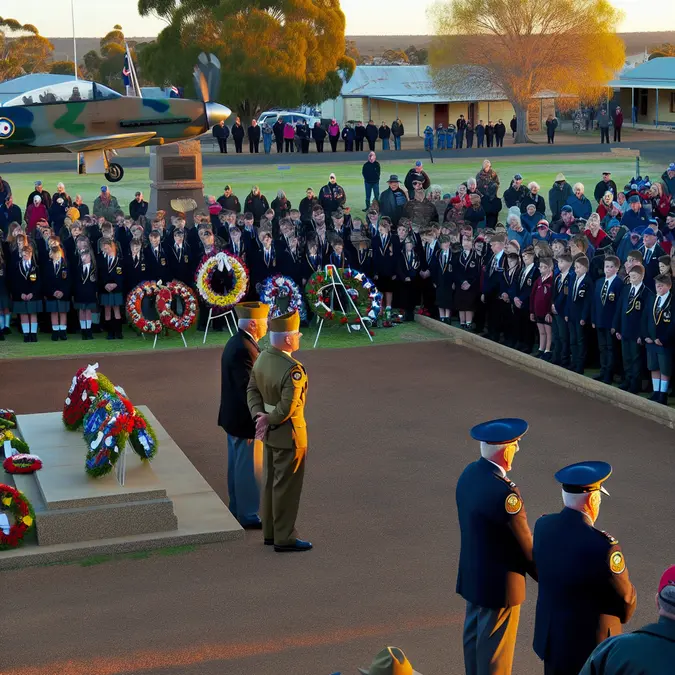
As the sun rises over Narrogin’s Memorial Park on Anzac Day 2026, the community will again gather before the cenotaph, recite familiar words and fall silent in collective memory. When the Royal Australian Air Force flyover thunders above, the moment will crystallise a century of sacrifice while pointing toward an uncertain but shared future.
For readers across Australia and beyond, the Narrogin commemoration offers a clear message: national identity is not forged only in parliaments or capitals, but also in regional parks where names on stone meet living generations. Anzac Day 2026 shows that remembrance can be both traditional and adaptive, solemn and visually compelling, deeply local yet part of a wider global conversation about war, peace and responsibility.
In recognising the significance of Anzac Day 2026, we recognise, above all, the enduring human drive to remember, to learn and to strive for a world where the sacrifices we honour need never be repeated.