
 0
0
 0
0
www.tnsmi-cmag.com – Environmental investment is no longer a buzzword reserved for big corporations or city-based innovators; it is now reshaping how local farm shops operate, grow, and connect with their communities. A popular Shropshire farm shop making headlines by “going even more green” with fresh sustainability spending captures a much wider trend: rural businesses turning climate ambition into concrete, profit-driving action.
Environmental investment and the new era of green farm shops
Across the UK and beyond, rural retailers are under pressure to adapt. Supply-chain shocks, rising energy bills, extreme weather, and changing consumer expectations have converged into a powerful incentive: invest in greener operations or risk being left behind. In this context, environmental investment is emerging as a strategic tool, not a cosmetic add-on.
The Shropshire example illustrates several key dynamics:
- Customers expect visible environmental responsibility, from energy sources to packaging.
- Government incentives make on-site renewables and efficiency upgrades more accessible.
- Local food systems are being reframed as pillars of climate resilience and community well-being.
While the original report highlights a single farm shop, the story is emblematic of a global shift in agri-retail. Readers who follow Business and Sustainability trends will recognize this as part of a broader restructuring of how we produce, sell, and consume food.
Why environmental investment is becoming essential for rural retailers
To understand why farm shops are doubling down on environmental investment, we need to look at three converging forces: economics, regulation, and consumer behavior.
Environmental investment as a hedge against rising costs
Energy and input prices have become volatile in recent years. According to the UK government's own assessments, energy-intensive sectors and rural businesses are among the most exposed to price shocks. For a farm shop running chillers, freezers, lighting, and on-site processing facilities, electricity is a major line item.
Targeted environmental investment can reduce this exposure. Common measures include:
- Solar photovoltaic panels on rooftops and carports to generate daytime power.
- LED lighting retrofits to cut electricity usage and maintenance costs.
- Improved insulation and refrigeration technology to minimize energy losses.
- Smart energy management systems that optimize equipment schedules and loads.
Each of these actions typically pays back over a period of years, after which reduced utility bills translate into a competitive advantage. In an era of narrow margins, the ability to lock in lower operating costs is strategic, not optional.
Regulation, incentives, and the direction of travel
Regulatory frameworks increasingly nudge or require businesses to measure and reduce their environmental footprint. The UK's commitment to net zero by 2050, for example, sends a long-term signal to investors and operators alike. While small farm shops are not the first targets of complex reporting rules, they sit within wider supply chains that are under scrutiny.
At the same time, public policy offers carrots as well as sticks. Grants for rural decarbonization, subsidies for renewable energy, and low-interest loans for green infrastructure are becoming more common. Detailed background on these policy trends can be found through sources such as the UK government's climate policy briefings and international analysis by organizations like the International Energy Agency.
For a forward-looking farm shop owner in Shropshire or anywhere else, the strategic question is clear: how can today's environmental investment position the business to comply with tomorrow's rules while capturing near-term benefits?
Consumer expectations: from niche "green" to mainstream demand
Consumer research consistently shows that shoppers, especially younger demographics, prefer brands and outlets that demonstrate credible environmental responsibility. Surveys by major consultancies and academic institutions indicate that many consumers are willing to switch retailers based on perceived sustainability performance, even if price remains a factor.
Farm shops occupy a unique place in this landscape. They already trade on authenticity, locality, and traceability—attributes closely aligned with sustainability. By making visible environmental investment decisions, such as installing solar arrays, reducing plastic, or showcasing carbon-conscious supply chains, they strengthen their core brand proposition.
In other words, for a modern farm shop, going "even more green" is not a gimmick; it reinforces the very reason many customers walk through their doors instead of choosing a supermarket.
7 powerful ways environmental investment is transforming farm shops
Let's dive deeper into seven practical areas where environmental investment is changing how progressive farm shops operate, including those like the Shropshire business making recent headlines.
1. On-site renewable energy and energy storage
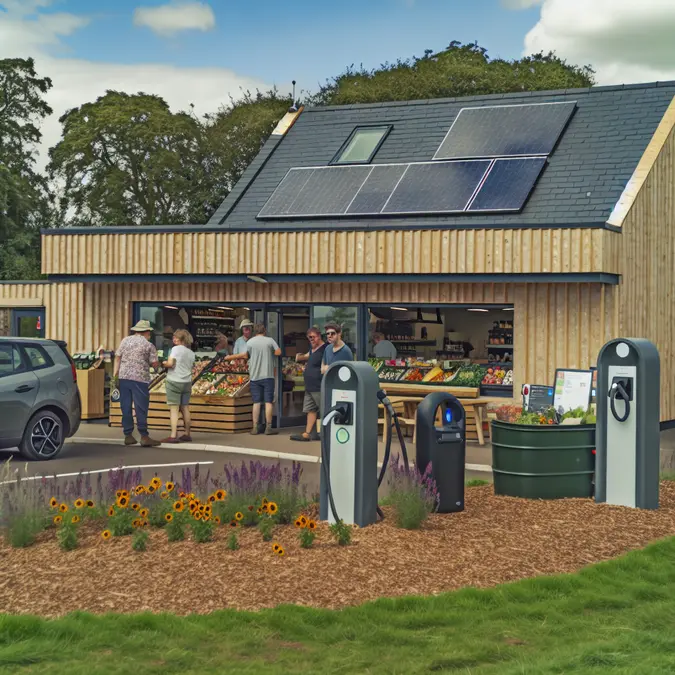
Solar panels on roofs, barn structures, and car parks are becoming a signature feature of environmentally focused farm shops. Some sites supplement solar with small-scale wind turbines or biomass boilers, depending on local conditions and planning rules.
This environmental investment achieves multiple objectives:
- Reduces dependence on grid electricity and fossil fuels.
- Stabilizes long-term energy costs.
- Demonstrates visible commitment to climate goals.
Increasingly, we are also seeing battery storage systems paired with renewables. These allow a farm shop to store excess power generated during sunny hours and use it during peak demand, boosting self-consumption and resilience during outages.
2. Smarter building design and retrofits
New builds and refurbishments alike are incorporating sustainability principles. That includes high-performance insulation, triple glazing, natural daylighting, and efficient heating, cooling, and ventilation systems.
For older farm shops housed in traditional buildings, retrofitting can be challenging but highly rewarding. Measures such as:
- Insulating roofs and walls where feasible.
- Installing heat pumps instead of oil or gas boilers.
- Upgrading refrigeration units to low-global-warming-potential refrigerants.
These upgrades can substantially cut emissions and costs. While they require upfront environmental investment, they often pay off faster as energy prices rise and efficiency standards tighten.
3. Sustainable sourcing and shorter supply chains
Farm shops have always championed local produce, but the environmental dimension of sourcing decisions is now front and center. Many are working directly with nearby growers and producers to reduce food miles, avoid unnecessary packaging, and align on shared climate targets.
By investing in digital supply-chain tools, traceability systems, and collaborative planning, farm shops can quantify the impact of these choices. Some adopt certification frameworks or align with standards such as those explained in depth on Wikipedia's sustainable agriculture page to communicate their practices more clearly.
Here, environmental investment often takes an intangible form: time and resources devoted to building relationships, gathering data, and redesigning logistics. The commercial payoff lies in deeper customer trust and a differentiated market position.
4. Circular packaging and waste reduction
Packaging waste has become a flashpoint in public debates about sustainability. Forward-thinking farm shops are turning this challenge into an innovation arena. Refill stations for dry goods, reusable containers programs, compostable packaging trials, and deposit-return schemes are moving from experimental to mainstream.
On the back end, many farm shops invest in improved waste segregation, on-site composting, and partnerships with anaerobic digestion plants. By treating waste as a resource stream rather than a cost center, they reduce landfill use and sometimes even generate secondary revenue or inputs (such as compost for on-site gardens).
This type of environmental investment requires staff training, customer engagement, and sometimes reconfigured store layouts—but it aligns closely with consumer expectations for low-waste shopping experiences.
5. Biodiversity, landscape, and on-farm experiences
Unlike urban supermarkets, many farm shops sit within working landscapes. That gives them a rare opportunity: turning biodiversity and habitat restoration into visible customer experiences.
Common measures include:
- Planting wildflower meadows and pollinator-friendly borders.
- Creating nature trails, ponds, or educational signage about local wildlife.
- Restoring hedgerows, woodland patches, and wetland areas.
While some of these actions attract grants or stewardship payments, they still count as strategic environmental investment. Visitors increasingly seek destinations that offer more than a transaction; they want connection, learning, and a sense of contribution. A well-designed green landscape can turn a farm shop into a day-out destination, boosting café revenues, event bookings, and brand loyalty.
6. Digital transparency and carbon accounting
The most advanced farm shops are beginning to quantify and communicate their environmental performance in structured ways. Carbon accounting tools, lifecycle analyses, and digital dashboards—once the preserve of major corporations—are trickling down to smaller enterprises.
By investing in these systems, farm shops can:
- Identify their biggest emissions hotspots.
- Prioritize high-impact environmental investment.
- Share credible metrics with customers, suppliers, and lenders.
Transparency becomes a trust-building asset. For lenders and investors, clear data de-risks future lending. For customers, it offers assurance that sustainability claims are evidence-based, not just marketing language.
7. Community engagement and education
Finally, many farm shops are embracing a role as community educators on sustainability. Workshops on seasonal eating, food preservation, home composting, and regenerative agriculture are gaining traction. School visits and partnerships with local groups turn the site into a hub for practical climate literacy.
Although such activities may seem peripheral, they are an intentional form of environmental investment in social capital. A community that understands and values sustainable practices is more likely to support businesses that lead the way—and more likely to resist short-term policy decisions that undermine long-term environmental goals.
The Shropshire signal: what this tells us about the future of rural business
The Shropshire farm shop doubling down on green upgrades is not acting in isolation. It signals how environmental and economic realities are converging in rural economies. Similar stories are emerging across England, Wales, Scotland, and other parts of Europe, as well as in North America and Australasia.
Three implications stand out for readers and business leaders:
- Early movers will shape expectations. When one prominent local business makes a bold environmental investment, it raises the bar for competitors. Over time, what began as a differentiator becomes the baseline customers expect.
- Access to finance will favor green strategies. Banks and investors are aligning their portfolios with climate objectives. Businesses that can demonstrate robust sustainability plans, backed by data, will likely secure better terms.
- Policy will continue to tighten. Whether through carbon pricing, building standards, or waste regulations, the direction of travel favors those who anticipate and invest early.
For many farm shops, the decision is shifting from "Should we invest in sustainability?" to "How fast and how far can we go, given our resources?"
Practical steps for farm shops considering environmental investment
For operators inspired by the Shropshire example, a structured approach helps avoid missteps and maximize returns. A typical roadmap might include:
Assess current performance and quick wins
Start with an energy and resource audit. Where are the biggest costs and emissions? Lighting, refrigeration, and heating often emerge as priority areas. Modest environmental investment in controls, insulation, or equipment settings can yield rapid savings.
Engage staff and customers early
Environmental changes affect daily operations and customer experience. Involving employees in planning can surface practical insights and build ownership. Likewise, communicating plans to customers—through signage, newsletters, or social media—can generate goodwill and useful feedback.
Leverage partnerships and available funding
Local authorities, rural development agencies, and industry groups often provide guidance, case studies, and sometimes grants. Collaborating with nearby farms, renewable-energy cooperatives, or universities can lower risk and share learning. Readers can explore more background on rural sustainability programs via government portals and specialist media, including coverage on TNSMI-CMAG itself.
Plan for the long term
The strongest environmental investment strategies align with a 5–15 year vision for the business. That includes anticipating technology shifts—such as electric vehicle charging demand or advances in agri-voltaics—and designing today's upgrades with future integration in mind.
Contrary to the perception that sustainability is a cost center, the emerging evidence suggests that well-planned environmental investment can enhance resilience, unlock new revenue streams, and deepen customer loyalty.
Conclusion: environmental investment as a cornerstone of modern farm retail
The Shropshire farm shop choosing to go "even more green" encapsulates a decisive pivot taking place in rural commerce. What once might have been framed as a public-relations gesture has become a core strategic choice. From solar panels and smart buildings to circular packaging, biodiversity projects, and community education, environmental investment is redefining what it means to be a successful, future-ready farm shop.
For readers watching this space—whether as business owners, policymakers, or informed consumers—the message is clear: those who embrace environmental investment today are not just responding to climate challenges; they are actively designing the resilient, community-centered food systems of tomorrow.