
 0
0
 0
0
www.tnsmi-cmag.com – quick commerce is rapidly emerging as the most hotly contested battlefield in Indian consumer internet, with Swiggy, Zepto, Blinkit and others racing to claim the crown in a market defined by 10–20 minute deliveries, larger assortments, and relentless execution.
Quick Commerce: India’s Fastest-Growing Retail Frontier
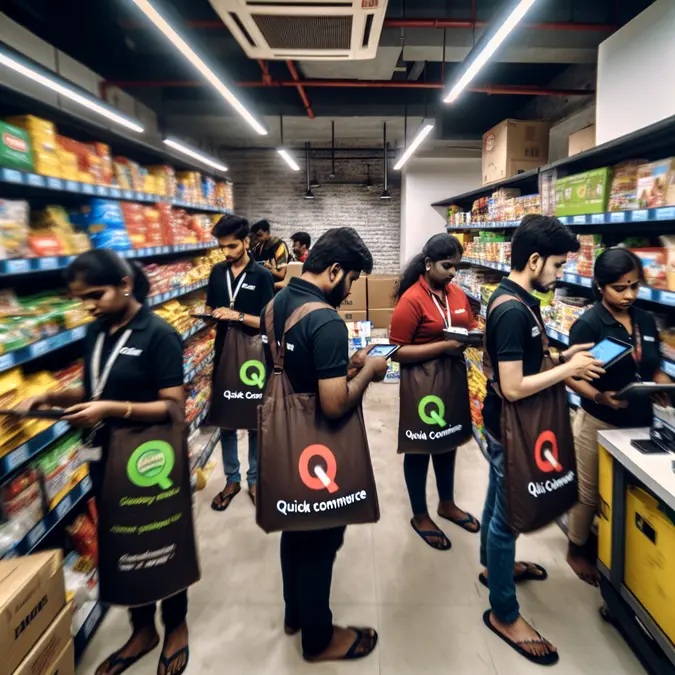
Over the past three years, quick commerce has evolved from an experiment in urban grocery delivery to a mainstream retail phenomenon. The promise is simple yet powerful: deliver everyday essentials, groceries, snacks, and even electronics to consumers’ doorsteps in less than 30 minutes. Behind this promise lies a complex network of dark stores, data-driven inventory planning, and hyper-local logistics.
India’s consumer base is young, mobile-first, and increasingly time-poor. As more households join the urban middle class, their willingness to pay a premium for convenience continues to rise. In this environment, companies like Swiggy Instamart, Zomato-owned Blinkit, and Zepto are fighting for dominance. Each player is not merely competing on speed, but on assortment breadth, pricing intelligence, delivery reliability, and long-term profitability.
According to multiple industry estimates, India’s quick commerce market could cross several billion dollars in gross merchandise value (GMV) within the next few years, riding on the back of shifting consumer behavior and maturing digital infrastructure. Yet, beneath the attractive growth figures, critical questions remain: Who will win the quick commerce crown? How sustainable is the 10-minute delivery model? And what does this mean for India’s broader retail and logistics ecosystem?
Quick Commerce and the Battle for Market Leadership
The headline competition today centers on three brands: Swiggy Instamart, Blinkit, and Zepto. Each brings a distinct strategy and legacy to the quick commerce battleground.
Quick Commerce Strategies: Why Assortment Is Swiggy’s Big Bet
Sriharsha Majety-led Swiggy, historically known for its food delivery dominance, is now betting aggressively on Instamart to secure a leadership position in quick commerce. Its emerging thesis: consumers do not only want speed; they also want choice. That is why Swiggy is leaning into a significantly larger assortment across categories, from fresh produce and staples to household goods, personal care, OTC medicines, and even impulse categories like gourmet snacks and beverages.
This focus on assortment responds to an evolving reality: the average cart on a quick commerce platform is no longer a last-minute snack order. It increasingly resembles a micro version of a monthly grocery basket. If a platform can become the default destination for both urgent top-ups and medium-sized planned baskets, its retention and order frequency go up dramatically.
However, a friction emerges: the broader the assortment, the more complex the supply chain. Dark stores must balance limited shelf space with high SKU (stock-keeping unit) variety, while ensuring minimal stockouts. This pushes operators to invest heavily in demand forecasting algorithms, local preferences mapping, and vendor integration. The platforms that master this balance between breadth and operational discipline will enjoy a clear strategic advantage.
Zepto, Blinkit and the Speed-First Proposition
While Swiggy is leaning into assortment, rivals such as Zepto and Blinkit have built their brands on the back of ultra-fast fulfillment — often promising deliveries in 10 minutes or less in dense urban centers. For many first-time users, that immediacy created a memorable wow factor, similar to what food delivery did a decade ago.
Speed, however, is a double-edged sword. To sustain such rapid deliveries at scale, platforms must invest in a tightly packed network of dark stores, extremely optimized routing, and high rider density. This model can work in metros and Tier-1 cities, but its economics in smaller markets and low-density areas are still being tested.
As investors and public markets increasingly demand a path to sustainable profitability, these companies are fine-tuning their promises: shifting some locations to 15–20 minute delivery windows, introducing delivery fees, and offering differentiated service levels for loyalty members. The race for the quick commerce crown is therefore gradually shifting from an arms race on speed to a more balanced game of speed, assortment, and unit economics.
Unit Economics: Can Quick Commerce Become Profitable?
The sustainability question sits at the heart of the quick commerce debate. Critics argue that the current model subsidizes hyper-convenience at the expense of sound business fundamentals. Supporters counter that, just like e-commerce and food delivery before it, unit economics will improve through scale, operational optimization, and better monetization levers.
Key Cost Drivers in Quick Commerce
To understand where profitability can emerge, we must break down the key cost drivers:
- Last-mile delivery: Rider payouts, fuel, and incentives are a substantial part of every order’s cost. As order density increases in a given locality, the cost per delivery falls.
- Dark store operations: Rent, staff, utilities, and shrinkage (wastage, pilferage) must be amortized across thousands of orders. Efficient layout design and inventory turnover are crucial.
- Discounts and promotions: Consumer acquisition in quick commerce has historically relied on heavy discounts and cashback. Rationalizing these while maintaining growth is a delicate balancing act.
- Technology and overhead: Routing algorithms, inventory management software, and corporate overhead add to fixed costs, but scale can dilute these over time.
On the positive side, platforms are unlocking revenue levers such as in-app advertising, higher-margin private labels, and subscription programs. For instance, paid loyalty plans can offer free deliveries and exclusive deals while smoothing revenue through recurring fees. In-app banners and sponsored product placements turn high-frequency user traffic into an attractive advertising real estate for brands.
Global experience is instructive here. In markets like Europe and the United States, q-commerce models have gone through cycles of rapid expansion and consolidation, forcing players to focus on density and profitability rather than pure growth. Indian operators are studying these lessons closely while adapting them to local price sensitivity and purchasing patterns.
Urban Infrastructure, Hospitals, and the Logistics Parallel
The original news hook also flagged a different but connected challenge: India’s hospital shortage. At first glance, health infrastructure and quick commerce may seem unrelated, but both expose a common reality — India’s urban and semi-urban infrastructure is under intense pressure from demographic growth and rising aspirations.
Solving India’s Hospital Shortage: Lessons from Quick Commerce
India continues to fall short of the ideal doctor-to-patient and bed-to-population ratios recommended by global bodies such as the World Health Organization. Many Tier-2 and Tier-3 cities lack adequate secondary and tertiary care facilities. As private and public sectors search for solutions, the underlying logistical intelligence powering quick commerce could offer valuable frameworks.
Dark store networks and micro-fulfilment centers have shown how high-frequency demand can be served efficiently through distributed nodes rather than a few large hubs. Although healthcare must observe stricter regulatory, ethical, and quality constraints, policymakers and hospital chains can borrow concepts like demand mapping, geospatial planning, and dynamic capacity allocation. For instance:
- Heat maps of population density and disease incidence can guide where new clinics or small hospitals should be built, similar to how quick commerce players choose dark store locations.
- Telemedicine and e-pharmacy services can act as digital front doors, complemented by strategically located physical centers, mirroring hybrid online–offline retail networks.
- Predictive analytics can anticipate peak loads — flu seasons, pollution spikes, or local outbreaks — allowing hospitals to flex capacity, staff, and critical supplies.
In other words, the same data-driven, network-based thinking that powers rapid delivery can inspire more agile, resilient health infrastructure planning for India’s next decade.
Consumer Behavior: Why Quick Commerce Is Here to Stay
For many urban Indians, quick commerce has already become part of daily routine. Need fresh coriander for dinner? Out of baby diapers at midnight? Hosting sudden guests? The mental model has shifted from planning all purchases in advance to a just-in-time mindset.
Several structural factors suggest that this shift is not a temporary pandemic-era spike, but an enduring behavioral change:
- Rising digital fluency: UPI payments, mobile wallets, and affordable data have normalized online transactions even for low-ticket items.
- Time scarcity: Dual-income households and long commutes make physical grocery runs less attractive.
- Trust in delivery: Years of e-commerce and food delivery have made consumers comfortable with strangers handling their purchases.
- Habit formation: Once a quick commerce app solves a high-stress, time-sensitive problem, loyalty often deepens.
At the same time, brands and FMCG companies recognize these platforms as powerful marketing and distribution partners. High-visibility placements on quick commerce apps can directly translate into incremental sales, particularly for impulse-driven categories like snacks, beverages, and beauty products. That creates a reinforcing loop where platforms gain more advertising revenue, invest in better assortment, and further cement user loyalty.
Regulation, Labor, and the Social Contract
No analysis of quick commerce is complete without addressing the broader social contract around gig work, urban safety, and regulation. As delivery timelines get tighter, concerns arise about rider well-being, traffic safety, and fair compensation.
Many platforms publicly state that they do not pressure riders to break traffic rules and that incentives are designed around completed tasks rather than pure speed. Nonetheless, anecdotal reports of risky riding behavior prompt a necessary regulatory conversation. City authorities are beginning to look at zoning rules, parking infrastructure, and traffic management with the growth of delivery fleets in mind.
On the labor front, the debate around gig worker protections — insurance, social security, and predictable earnings — is intensifying. For quick commerce to retain its social license to operate, platforms must demonstrate responsible practices and transparent communication. Trust, after all, is not only about delivering products on time; it is also about how companies treat the people who make those deliveries possible.
What This Means for Traditional Retail and Malls
Traditional kirana stores, supermarkets, and shopping malls are watching the quick commerce wave with mixed feelings. On one hand, they face increased competition for basket share. On the other, many are discovering that partnering with platforms can unlock new revenue streams.
Some quick commerce players are experimenting with hybrid models, where local kiranas act as inventory partners or pick-up points. This allows small retailers to tap into digital demand without building their own technology or delivery fleet. Shopping malls and large-format retailers, meanwhile, are exploring integrations that let them offer 30–60 minute local deliveries from their existing stores, capturing the convenience segment without massive capex on dark stores.
Readers interested in the broader impact of digital transformation on Indian industries can explore our coverage in Business and the future of urban infrastructure in Technology sections on our site.
Quick Commerce: 7 Critical Trends to Watch
As India’s quick commerce narrative unfolds, seven trends are particularly worth tracking over the next 24–36 months:
- Assortment expansion beyond groceries: From electronics accessories to pharmacy SKUs and beauty products, expect platforms to become broad convenience marketplaces.
- Tier-2 and Tier-3 expansion: Operators will selectively enter smaller cities, testing new delivery-time promises and lower-cost formats adapted to local density.
- Profitability focus: Discounts will moderate as companies prioritize contribution margin, subscription products, and advertising revenues.
- Private labels and exclusives: Just as large e-commerce firms did, quick commerce apps will push house brands in staples and snacks to improve margins.
- Cross-category bundling: Expect more curated packs — festival kits, party packs, emergency bundles — designed to lift average order value.
- Regulation and worker protections: Policymakers will likely define clearer frameworks for gig work, insurance, and safety standards.
- Consolidation and alliances: As capital tightens, weaker players may exit or merge, and strategic partnerships with large retailers or logistics companies will deepen.
Ultimately, the winner of India’s quick commerce crown will not be the brand that delivers the fastest single order, but the one that marries speed, scale, assortment, profitability, and trust in a coherent, durable model.
Conclusion: Quick Commerce and the Future of Indian Consumption
Quick commerce has moved from being a curiosity to a central pillar of India’s digital consumption story. As Swiggy, Zepto, Blinkit and others refine their strategies, the sector will shape not just how we buy groceries, but how retailers, brands, city planners, and even hospital operators think about on-demand service delivery.
For readers tracking India’s economic trajectory, this is more than a race for a convenience crown. It is a live experiment in building real-time, data-rich infrastructure for a billion-plus people. The lessons from quick commerce — both its successes and its growing pains — will echo across healthcare, mobility, and urban services in the coming years. Whoever ultimately wins the quick commerce crown, the biggest beneficiary will likely be the Indian consumer, whose expectations from every other sector will be rewritten by the standards of speed, reliability, and choice that this industry is now setting.