
 0
0
 0
0
www.tnsmi-cmag.com – Indian women at workplaces are at the heart of a profound labour market transition in India, even as millions of gig workers remain trapped in low-paying, insecure jobs and platforms like Swiggy report widening losses.
India’s Economic Survey 2025-26 points to a renewed rise in women’s workforce participation, a trend that could reshape growth, consumption, and social norms. At the same time, policymakers are sounding a clear warning: unless regulations and incentives evolve, workers—especially women and youth—will remain pushed into gig work by necessity, not choice. The Survey argues that policy must help workers shift towards gig work willingly, with protections and pathways to prosperity rather than precarity.
This tension between rising participation by Indian women at workplaces and the persistence of low-paying gig work sits at the core of India’s next economic chapter. Swiggy’s Q3 FY2025 loss of Rs 1,065 crore underscores how fragile the platform economy itself remains—a fragility that often passes risks down the line to the very workers who keep it running.
Indian women at workplaces: 7 critical shifts in India’s labour market
To understand where India is headed, readers must look beyond headline numbers and dive into the structural shifts shaping jobs, wages, and workplace norms. Below are seven critical dynamics transforming the landscape for Indian women at workplaces and gig workers nationwide.
1. Indian women at workplaces and the post-pandemic participation rebound
For years, India battled a paradox: high economic growth alongside stubbornly low female labour force participation. As per global labour statistics, India has consistently trailed peers such as China, Bangladesh, and Vietnam in bringing women into formal and paid work. The Economic Survey 2025-26 now highlights a welcome reversal, with more women entering or re-entering the workforce.
Several forces fuel this resurgence:
- Economic necessity: Post-pandemic income shocks pushed many households to seek a second or third earner, drawing more women into paid work.
- Digital inclusion: Widespread smartphone adoption and low-cost data have opened new earning channels—from online tutoring and telemedicine support to home-based e-commerce.
- Expanding services economy: Growth in retail, healthcare, education, and business services has created more urban and semi-urban opportunities suitable for women with varying skill levels.
Yet, raw participation alone does not guarantee empowerment. Many Indian women at workplaces remain concentrated in informal, poorly paid, and insecure roles—an issue magnified in the gig economy.
2. The gig work puzzle: choice vs compulsion
The Economic Survey’s framing of gig work is unusually candid. It urges policymakers to help workers move into gig roles by choice, not because they are locked out of formal employment. This distinction matters profoundly for Indian women at workplaces trying to balance caregiving, safety concerns, and income needs.
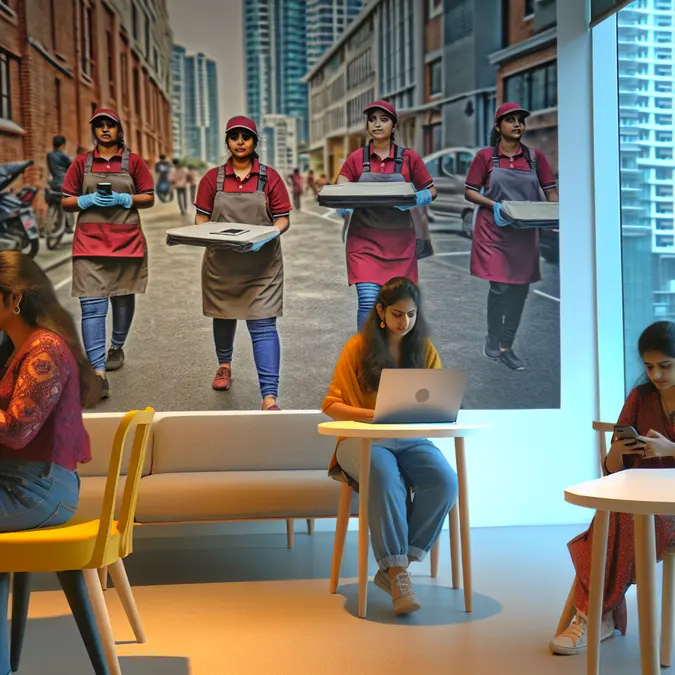
Today, for a large share of gig workers, including delivery agents, ride-hailing drivers, beauticians, and on-demand domestic staff, gig work is less a flexible opportunity and more a last resort. Key concerns include:
- Low and volatile pay: Earnings fluctuate with algorithms, demand cycles, and incentive schemes that workers neither design nor control.
- Lack of social security: Most platform workers do not receive provident fund, health insurance, or paid leave, leaving them one illness away from financial distress.
- Opaque rating systems: Algorithms and customer ratings can impact access to future work, often without transparency or recourse.
For women gig workers, these vulnerabilities are layered on top of existing gender gaps in pay, mobility, and household expectations. Policy, therefore, cannot treat gig workers as a homogenous category; it must explicitly account for the realities of Indian women at workplaces, whether they sit in offices, travel for deliveries, or log in from their homes.
3. Swiggy’s widening losses and what they mean for workers
Swiggy’s Q3 loss widening to Rs 1,065 crore sends a crucial signal: the platform business model is still under pressure, even after years of rapid scale-up. While investors largely focus on profitability and market share, workers feel the impact more directly and immediately.
When platforms chase profitability under funding pressure, they typically pull three levers:
- Reduce per-order payouts or incentives for delivery partners.
- Increase workload expectations (more orders per hour, longer distances).
- Introduce or hike platform fees and penalties paid by workers.
Each of these moves erodes effective hourly wages and makes livelihoods more precarious. Leading international analyses of gig economies show similar patterns from California to London: when margins tighten, worker security is often the first casualty.
In India, where minimum wage enforcement is already weak and social protection coverage narrow, platform instability compounds labour fragility. For women delivery partners—who face additional barriers such as safety risks, caregiving duties, and restricted late-night work—the downside risks are even steeper.
How Indian women at workplaces are using (and resisting) gig work
Indian women at workplaces interact with the gig economy in complex, often contradictory ways. Some embrace platforms as a route to flexibility and supplemental income. Others experience gig work as a trap of long hours and meagre pay, with little upward mobility.
4. Flexibility vs precarity: the double-edged sword
For many women, gig platforms offer one undeniable advantage: time flexibility. The ability to log in during school hours, pause work during family emergencies, or take on short bursts of assignments appeals strongly to mothers, caregivers, and students. Examples include:
- Beauty and wellness professionals on home-service platforms.
- Online tutors, counsellors, and trainers using edtech or telehealth platforms.
- Home chefs and artisans selling through marketplace apps and social commerce.
However, this flexibility frequently comes at the cost of predictability and protection. Variable demand, algorithmic visibility, and the absence of guaranteed minimum earnings mean that workers shoulder business risks traditionally borne by employers. In practice, many women end up stitching together multiple gigs, often late at night or early in the morning, just to stabilize their monthly income.
In such an environment, the central question is not simply how many Indian women at workplaces enter gig work, but under what terms—and who sets those terms.
5. Safety, mobility, and the invisible costs of gig work for women
Readers cannot fully grasp the stakes without acknowledging the safety and mobility constraints that shape women’s choices. For on-the-road gig roles such as food delivery, bike taxis, or logistics, women face:
- Harassment or unsafe interactions on the street or at customer locations.
- Limited access to personal vehicles or driving licenses.
- Family resistance to late-night or long-distance work.
Even for home-based digital gigs, women often shoulder unpaid domestic labour before and after paid assignments. This “double shift” erodes their rest and long-term health, while the economy undercounts their total contribution. Thoughtful policy, urban design, and platform safety protocols must converge if India wants more women to participate meaningfully and sustainably in the workforce.
Our coverage on labour, entrepreneurship, and the future of work at Economy shows that when safety and infrastructure improve, women’s participation tends to rise in parallel. The same principle will apply to the gig ecosystem.
Policy priorities: from low-paying gig jobs to dignified work
The Economic Survey’s call to support voluntary movement into gig work creates a useful policy lens. Instead of celebrating raw platform headcounts, policymakers should ask: Are these jobs lifting people out of poverty or locking them into it? Are Indian women at workplaces gaining autonomy, or just new forms of dependence?
6. Building a framework of protections for gig workers
Several policy options can help improve conditions for gig workers without stifling innovation:
- Portable social security: A universal, portable benefits framework—linked to workers rather than employers—would allow gig workers to carry health, accident, and retirement benefits across platforms.
- Minimum earnings benchmarks: Regulators can set transparent minimum earning standards tied to local living costs and working hours, ensuring that “flexible” work does not translate into legalised underpayment.
- Algorithmic transparency: Workers should have access to clear information on how ratings, incentives, and deactivations work, along with grievance redressal mechanisms.
- Gender-sensitive safeguards: Measures like verified customer identities, SOS support, safe-zone mapping, and shift-time protections can make gig roles safer and more viable for women.
Some of these ideas already appear in draft and enacted legislations across Indian states, as well as in international debates on worker classification. The challenge now lies in consistent enforcement and the political will to balance investor interests with worker rights.
7. Skilling, upskilling, and pathways out of low-paying gigs
Policy cannot focus only on cushioning the present; it must also build bridges to better jobs. For Indian women at workplaces, that means targeted skilling and upskilling tailored to real market demand.
Priority areas include:
- Digital and data skills: From basic digital literacy to data entry, coding bootcamps, and analytics support roles.
- Healthcare and eldercare: Structured training for nursing assistants, telehealth coordinators, and community health workers.
- Green and climate-resilient jobs: Skills for solar installation, waste management, and sustainable agriculture—sectors we regularly explore under Business analysis.
Crucially, these programmes must be:
- Accessible: Located near communities or delivered online with low data costs.
- Affordable: Supported by scholarships, stipends, or employer partnerships.
- Outcome-linked: Tied to actual job placements or income improvements, not just certificates.
When designed well, such pathways allow workers currently stuck in low-paying gigs to transition into more stable, higher-value roles—without losing the flexibility many women need.
Corporate responsibility: platforms, profits, and people
While government policy sets the floor, the ceiling for worker welfare will be determined by corporate choices. Platforms like Swiggy, Zomato, Ola, and others are no longer scrappy start-ups; they are systemic employers in all but legal classification. Their decisions affect hundreds of thousands of livelihoods and the broader perception of Indian women at workplaces in the platform economy.
Rethinking success metrics beyond GMV and valuation
As platforms chase profitability, they must redefine their success metrics to include worker welfare indicators such as:
- Median effective hourly earnings for workers on their platforms.
- Worker churn and satisfaction rates disaggregated by gender.
- Coverage levels for accident insurance, health benefits, and skilling programmes.
Investors, too, are beginning to scrutinise environmental, social, and governance (ESG) metrics more seriously. In the coming years, platforms that can prove they treat gig workers—especially women—fairly and transparently may enjoy reputational and regulatory advantages over those that do not.
India stands at a crossroads: it can become the world’s back-office for cheap labour, or it can leverage its demographic dividend to build a dignified, skilled, and inclusive workforce where women are central, not incidental.
The road ahead: from participation to real power for Indian women at workplaces
The renewed rise in women’s workforce participation is encouraging, but the story cannot end there. Participation without protection, pay equity, and progression risks becoming another statistic that looks impressive on paper and hollow in lived reality.
For Indian women at workplaces to move from the margins to the centre of economic life, India must pursue a three-part agenda:
- Protect: Enshrine basic rights and social security for all workers, including those on digital platforms.
- Promote: Design incentives and infrastructure that make it easier and safer for women to work—whether in offices, factories, homes, or on the road.
- Progress: Invest heavily in education, skilling, and career ladders that allow women to move beyond low-paying gigs into leadership, entrepreneurship, and specialised roles.
Readers should view Swiggy’s losses, the Economic Survey’s warnings, and the surge in gig work not as isolated data points but as interconnected signals. They reveal an economy in flux, searching for a balance between innovation and inclusion, flexibility and fairness.
In that search, the experiences of Indian women at workplaces—from corporate boardrooms to app-based delivery routes—offer the clearest lens on what is working, what is breaking, and what must urgently change. If India gets this transition right, it will not only lift millions out of low-paying jobs but also unlock a powerful, sustained growth engine driven by women’s full and fair participation in the world of work.