
 0
0
 0
0
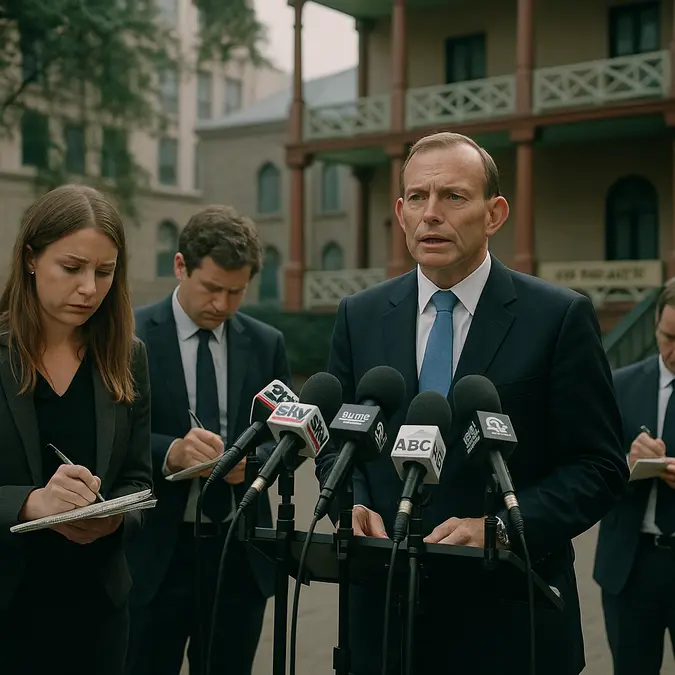
www.tnsmi-cmag.com – Former prime minister Tony Abbott has reignited a volatile debate inside the Liberal Party and across Australian politics by attacking what he calls an “activist” watchdog, as New South Wales Liberals quietly fear looming election chaos and deeper internal fractures.
Tony Abbott and the New Flashpoint Over Australia’s Political Watchdogs
Tony Abbott has never been a stranger to political confrontation. His latest broadside, aimed at a powerful integrity watchdog he labels “activist,” comes at a sensitive moment for the Liberal Party in New South Wales. With critical preselection battles unresolved and a federal and state electoral timetable accelerating, his comments are being read as both a warning and a weapon in an already fraught internal landscape.
While the original report from The Australian is paywalled, the public contours are clear: a senior Liberal figure challenging the conduct and reach of a key oversight body, and party officials fearing the fallout will compound existing disarray.
For readers trying to make sense of this clash, the key questions are straightforward but profound:
- Why is Tony Abbott targeting the watchdog now?
- How do integrity bodies operate in New South Wales?
- What does this dispute reveal about Liberal Party governance and internal democracy?
- Could this trigger broader election instability?
To unpack these issues, we need to situate Abbott’s intervention within the longer history of political oversight in Australia, the tensions between accountability and partisanship, and the Liberal Party’s own evolving power struggles.
Tony Abbott, Watchdogs and the Battle Over Political Integrity
When Tony Abbott denounces an “activist” watchdog, he is tapping into a polarising global narrative: the suggestion that unelected integrity bodies, courts, or commissions are overreaching and undermining democratic mandates. Similar arguments have surfaced in the United States in attacks on the Department of Justice, and in parts of Europe where independent institutions face sustained political pressure.
In the Australian context, watchdogs such as the New South Wales Independent Commission Against Corruption (ICAC) and newer bodies like the National Anti-Corruption Commission (NACC) were designed to respond to entrenched public concerns about corruption and backroom influence. According to ICAC’s own charter, its purpose is to “investigate, expose and minimise corruption” in the NSW public sector. That mission necessarily brings it into contact with politicians, donors, and party structures.
Abbott’s criticism appears to follow a familiar script: watchdogs are no longer simply referees, he implies, but political players in their own right. The use of the term “activist” is deliberate. It suggests ideological bias, discretionary zeal, and an eagerness to shape outcomes, rather than apply rules neutrally.
However, framing a watchdog as “activist” often says as much about the accuser as the accused. It invites readers to ask: is the problem the watchdog’s behaviour, or the discomfort of political actors who suddenly find their once-private processes exposed to scrutiny?
Tony Abbott, NSW Liberals and the Fear of Election Chaos
Inside the New South Wales Liberal Party, the timing of Tony Abbott’s attack is particularly sensitive. The party has endured years of factional turmoil, preselection disputes, and contestation over who truly controls candidate pipelines. These internal struggles have already delayed or disrupted campaigning in key seats at both state and federal levels.
Reports of “election chaos” reflect a convergence of factors:
- Factional rivalry: Long-running tensions between conservative and moderate blocs over candidate selection and policy direction.
- Late preselections: Battles that drag on to the last minute, weakening ground campaigns and fundraising.
- Legal and procedural challenges: Internal rules challenged in courts or party tribunals, sometimes intersecting with external watchdog scrutiny.
In this environment, Abbott’s intervention adds another layer of uncertainty. If party activists and sitting MPs come to view watchdogs as partisan enemies rather than neutral arbiters, they may respond in one of two ways: retreat into defensive secrecy, or escalate public warfare. Either path risks deepening instability.
For a broader contextual lens on party conflict and political institutions, readers may find useful parallels in academic analyses of party systems and accountability, such as those surveyed in the political party entry on Wikipedia, which highlight how internal democracy and oversight structures can either stabilise or fracture organisations.
Tony Abbott and the Politics of ‘Activist’ Oversight
Tony Abbott’s comments also operate at the level of political messaging. Calling a watchdog “activist” does several things at once:
- It rallies a base suspicious of bureaucracy and external control over elected officials.
- It reframes accountability as overreach, casting politicians as victims rather than subjects of legitimate scrutiny.
- It sets the stage for any future adverse findings to be dismissed as biased or ideological.
From a communications standpoint, this is a pre-emptive reputational defence: if an inquiry goes against allies or a faction, leaders can argue that the process was corrupted long before the outcome emerged.
However, this approach has clear risks. Over time, repeated attacks on watchdogs can erode public confidence not only in those bodies but in the broader integrity system. If voters begin to believe that every investigation is politically contaminated, then even well-founded findings may struggle to command respect.
For a professional audience concerned with governance quality, this is not a trivial side issue. It goes to the core of whether Australia can maintain a credible architecture of transparency, one that reassures investors, civil society, and international partners that rules are predictable and fairly enforced. Readers interested in the broader policy architecture may wish to explore how governance and accountability intersect in our coverage under Politics and Governance.
Five Critical Lessons From Tony Abbott’s Clash With the Watchdog
Beyond the immediate headlines, the dispute surrounding Tony Abbott offers five critical lessons about the state of Australian politics and the future of integrity oversight.
1. Tony Abbott Highlights the Fragile Legitimacy of Watchdogs
Integrity bodies rely on more than legal powers; they need public legitimacy. When a former prime minister suggests a watchdog is acting as an ideological player, it chips away at that perceived neutrality.
This fragility is not unique to New South Wales or to one watchdog. Around the world, independent institutions—from courts to anti-corruption agencies—face similar challenges. Their mandates are often broad, their investigations lengthy, and their work necessarily confrontational. Political actors, feeling exposed, may seek to delegitimise the institution rather than engage with its findings.
The lesson: oversight institutions must invest not only in legal robustness but in communicative clarity, explaining their processes, thresholds, and safeguards against bias in an accessible, disciplined way.
2. Tony Abbott Exposes Liberal Party Fault Lines
Abbott’s comments do not sit in a vacuum; they reverberate through Liberal Party corridors already crowded with disputes over preselections, branch stacking allegations, and internal discipline. When senior figures criticise watchdogs investigating or influencing internal processes, it can be read as a coded intervention in factional warfare.
For example, if a watchdog’s findings or inquiries touch on donors, powerbrokers, or particular local branches, a high-profile condemnation may embolden one faction and alienate another. The result can be paralysis at precisely the moment the party needs coherence to prepare for elections.
In professional terms, this is a governance stress test. Strong parties have transparent rules, predictable enforcement, and agreed mechanisms for handling disputes. When those structures falter, external oversight bodies inevitably become lightning rods for anger that is, in reality, directed at internal instability.
3. Tony Abbott Forces a Debate on the Mandate of Oversight
A third lesson from Tony Abbott’s attack is that Australia has not yet fully resolved how far watchdogs should go. Should they focus narrowly on individual acts of corruption? Or should they also scrutinise broader patterns of influence, systemic conflicts of interest, and party organisational practices?
Critics of “activist” watchdogs argue that expanding the mandate risks turning them into de facto political regulators. Supporters counter that modern corruption and undue influence do not always take the form of brown envelopes; they can manifest through opaque preselection deals, donor leverage, or patronage networks.
This debate will not be settled by one speech or one news cycle. It requires a structured national conversation: parliamentary reviews, expert panels, and genuine bipartisan engagement. Without that, each high-profile case will simply reproduce the same arguments, eroding trust further.
4. Tony Abbott Underscores the Stakes for Election Stability
The phrase “election chaos” is not used lightly. It signals fears that disorganised preselections, legal disputes, and internal party warfare may leave key seats without strong, properly endorsed candidates in time. Overlaying that instability with a public clash over watchdog legitimacy raises the stakes still further.
For businesses, community groups, and public institutions, uncertain political outcomes complicate planning. Unresolved candidacies, last-minute endorsements, and headline-grabbing integrity disputes make it harder to anticipate future policy directions.
From an operational standpoint, parties that allow internal governance to become a battleground rarely perform at their best in campaigns. The Abbott episode serves as a timely reminder: stable electoral contests require not only clear electoral laws but disciplined, internally accountable parties that respect both their own rules and the oversight bodies that sit above them.
5. Tony Abbott Reminds Us That Language Shapes Institutions
Finally, the way Tony Abbott frames his criticism matters. Calling a watchdog “activist” is more than a rhetorical flourish; it is an attempt to recast the institution in the public imagination. Over time, repeated use of such language can harden perceptions and give political leaders licence to sideline or restructure oversight mechanisms.
Conversely, defenders of watchdogs must avoid complacency. They, too, should be precise in language, transparent in process, and open to scrutiny of their own decision-making. Robust institutions accept that their power invites questioning, and they answer not with deflection, but with evidence.
In democratic systems, words often precede structural change. If the narrative of “activist watchdogs” becomes dominant, legislative reforms may follow, narrowing mandates or limiting tools. Those decisions will shape Australia’s integrity landscape for decades.
Where Tony Abbott’s Intervention Leaves Voters and Institutions
For voters, the immediate consequence of Tony Abbott’s attack may feel like yet another chapter in a long-running drama: politicians versus watchdogs, factions versus factions, and parties versus their own rules. Yet the underlying stakes are larger and more enduring.
At issue is whether Australia can sustain a credible balance between three imperatives:
- Strong, competitive political parties capable of contesting elections and governing effectively.
- Independent, respected integrity bodies that investigate misconduct without fear or favour.
- Public trust that both politicians and watchdogs operate within clear, democratically endorsed boundaries.
Reconciling these is not a one-off task; it is an ongoing negotiation embedded in law, practice, and political culture. Episodes like this one illuminate where the tensions lie and force institutions—and citizens—to decide what they value most.
For professional readers, the Abbott–watchdog clash should serve less as partisan spectacle and more as a case study in governance design. It challenges policymakers, lawyers, party operatives, and civil society leaders to ask: how do we build oversight systems that are powerful enough to matter, but accountable enough to retain cross-partisan legitimacy?
As debates continue, Tony Abbott’s intervention will remain a reference point in arguments about the proper reach of integrity bodies in New South Wales and nationally. Whether one agrees with his characterisation of an “activist” watchdog or not, the episode underscores how central these institutions have become to the functioning—and the perception—of modern Australian democracy.
In the months ahead, as NSW Liberals confront internal challenges and election timelines harden, the way leaders respond to watchdog scrutiny will signal to voters whether lessons have been learned or simply litigated in public once more. For now, Tony Abbott sits squarely at the heart of that debate, shaping how accountability, power, and party stability will be understood in the next electoral cycle.