
 0
0
 0
0
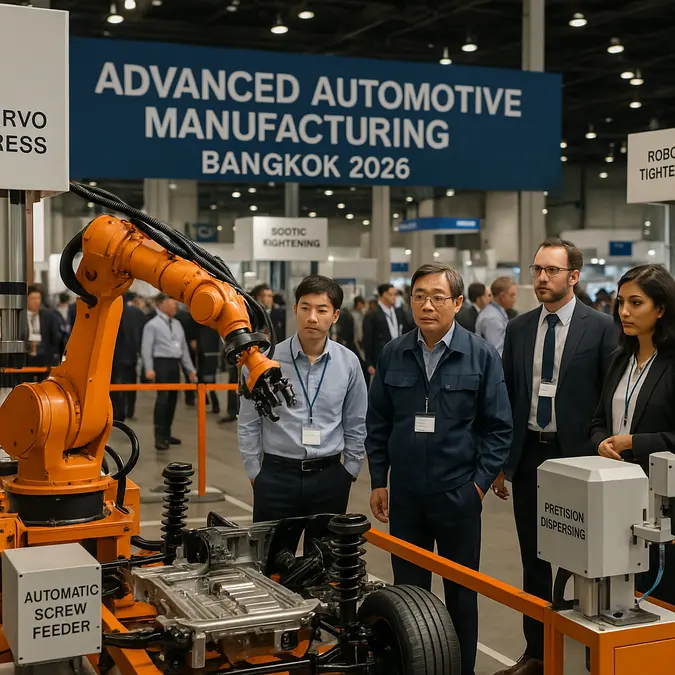
www.tnsmi-cmag.com – Automotive Manufacturing 2026 in Bangkok is rapidly becoming the strategic stage where the future of electric vehicle (EV) and automotive assembly in Southeast Asia is being written. As companies like Leetx unveil full-stack, self-developed assembly solutions — from servo presses and transducerized tightening to automatic screw feeding and precision dispensing — this regional trade show is evolving into a barometer of how fast factories, suppliers, and technology providers are pivoting toward smarter, cleaner, and more integrated production lines.
Automotive Manufacturing 2026 and the Rise of Full-Stack EV Assembly
The decision by Leetx to showcase a complete portfolio of self-developed assembly technologies at Automotive Manufacturing 2026 is more than a marketing move. It signals a deeper shift in how manufacturers approach EV and traditional automotive production: with vertically integrated, data-rich, and automation-heavy toolchains designed to operate as a unified whole rather than as isolated machines.
According to industry data from sources like the International Energy Agency, Southeast Asia is emerging as one of the most dynamic EV growth regions, with Thailand and neighboring countries targeting leadership positions in both vehicle assembly and parts manufacturing. Trade fairs in Bangkok have therefore become key launch pads for suppliers who want to prove that their technology can underpin this next phase of industrial growth.
Leetx's four self-developed product lines — servo presses, transducerized tightening systems, automatic screw feeding equipment, and Centron precision dispensing solutions — exemplify a trend that readers in manufacturing and engineering will recognize: the migration from generic, stand-alone tools to connected, software-defined, and analytics-ready assembly platforms.
How Automotive Manufacturing 2026 Reflects Southeast Asia's EV Ambitions
To understand the importance of Automotive Manufacturing 2026, we need to look beyond the exhibition halls. Thailand has long been known as the "Detroit of Asia," a regional hub for internal combustion engine (ICE) vehicle assembly and export. Now, national industrial policy aims to extend that role into the EV era, supported by tax incentives, infrastructure investment, and targeted support for component makers.
This policy backdrop explains why technology announcements at Bangkok trade shows matter. When an equipment provider presents a full-stack assembly solution, local automakers and Tier-1 suppliers assess more than performance specifications. They evaluate:
- Scalability: Can the technology support volume ramp-ups as EV adoption accelerates?
- Localization potential: Is the system open to local integration, training, and after-sales support?
- Data and traceability: Can the equipment feed into quality, compliance, and sustainability reporting frameworks?
- Cost of ownership: Does the solution reduce energy use, scrap, and downtime over the full lifecycle?
These questions will dominate conversations on the show floor in 2026 because Southeast Asia's EV supply chain must be competitive not just on labor costs but on digitalization, quality, and global compliance standards.
For readers seeking deeper context on Thailand's manufacturing ambitions, the country's industrial evolution has been documented across multiple analyses, including those by Reuters' Asia manufacturing coverage, which often highlights Bangkok's trade events as inflection points for regional investment decisions.
Inside Leetx's Technology Portfolio at Automotive Manufacturing 2026
Although the full technical documentation remains behind paywalls, the publicly available description of Leetx's participation at Automotive Manufacturing 2026 offers enough detail to decipher their strategic intent. The company is signaling that it can provide a tightly integrated assembly framework, covering four critical process pillars.
Automotive Manufacturing 2026 and the Role of Servo Press Technology
Servo presses lie at the heart of many modern automotive and EV production lines. Unlike traditional mechanical presses, servo-driven units provide precise control of force, displacement, and speed, enabling engineers to fine-tune joining processes for lightweight materials, battery housings, and structural components.
Leetx's decision to highlight a self-developed servo press line aligns with trends we see across the broader industry:
- Lightweighting: EVs require sophisticated joining of aluminum, ultra-high-strength steel, and composite components. Precision press control is non-negotiable.
- Battery safety: Battery pack assembly demands tight tolerances to avoid micro-cracks or stress points that could compromise thermal management.
- Data capture: Modern servo presses record force-distance curves and process signatures for each cycle, feeding into manufacturing execution systems (MES) for real-time quality monitoring.
By developing this technology in-house, Leetx can align hardware capabilities with its software and analytics stack, potentially reducing integration friction for customers in Thailand, Vietnam, Malaysia, and beyond.
Transducerized Tightening: Guaranteeing Traceable Joint Integrity
Transducerized tightening systems, another pillar of Leetx's portfolio, address one of the most mission-critical aspects of vehicle assembly: the integrity of fastened joints. In EVs, torque accuracy and traceability matter even more due to the presence of high-voltage components, battery enclosures, and new lightweight structures.
Transducerized tools measure torque and angle in real time, ensuring that each bolt reaches the correct specification. When connected to a plant's central data backbone, they allow:
- Full traceability for each fastener, down to vehicle identification number (VIN) level.
- Real-time quality gates that can stop a process if tolerance limits are exceeded.
- Predictive maintenance by monitoring tool performance and usage patterns.
At Automotive Manufacturing 2026, visitors will likely scrutinize how Leetx integrates tightening data into plant analytics dashboards and whether the company's systems can mesh with existing PLC and MES infrastructure. Readers who follow production engineering trends will recognize that this integration layer often differentiates generic tools from genuinely full-stack solutions.
Automatic Screw Feeding: Removing Bottlenecks in High-Mix Assembly
Automatic screw feeding may sound mundane compared with servo presses, but in high-volume, high-mix automotive environments, it can make or break overall line efficiency. Manual screw feeding introduces variability, ergonomic strain, and micro-delays that compound over thousands of units per shift.
Leetx's automatic screw feeding systems are presumably designed to work in tandem with its tightening tools, delivering:
- Consistent cycle times, crucial for takt time adherence.
- Reduced operator fatigue and improved ergonomics.
- Lower foreign object damage (FOD) risk, as loose fasteners are controlled and tracked.
For EV assembly, where electronics, sensors, and battery modules require delicate yet repeatable fastening, automated feeding becomes a vital enabler. It is part of the invisible infrastructure that allows plants in Southeast Asia to match — and eventually rival — the quality levels of established production bases in Europe and North America.
Centron Precision Dispensing: The Hidden Backbone of EV Reliability
The fourth product line, Centron precision dispensing, may carry less brand recognition, but it addresses a set of processes that directly influence EV reliability and longevity. Precision dispensing systems apply adhesives, sealants, thermal interface materials (TIMs), and potting compounds with controlled volume, speed, and placement.
In EVs and advanced ICE vehicles alike, such materials serve critical roles:
- Thermal management for battery packs, power electronics, and on-board chargers.
- Vibration damping and structural reinforcement for lightweight assemblies.
- Sealing against dust, moisture, and chemical ingress.
At Automotive Manufacturing 2026, potential buyers will look for closed-loop control features, inline inspection options, and compatibility with increasingly complex chemistries used in next-generation EV batteries and inverters. When dispensing operations are tightly integrated with upstream and downstream quality controls, they transform from potential failure points into powerful levers for warranty reduction.
Why Full-Stack, Self-Developed Technology Matters
Readers may ask: why does it matter whether these technologies are self-developed or sourced from multiple vendors? The answer lies in system integration, lifecycle cost, and digital transparency.
When an equipment supplier offers a full-stack portfolio, automakers can benefit from:
- Unified control architecture: Fewer protocol bridges, easier interoperability, and simplified troubleshooting.
- Consistent user interfaces: Reduced training time and operator errors.
- Harmonized data models: Clean integration into plant-wide analytics, quality dashboards, and even corporate sustainability reporting.
Self-development also creates accountability. If a servo press, tightening system, and dispensing unit all originate from one R&D ecosystem, the supplier cannot attribute performance gaps to third-party components. This accountability builds trust — a core pillar of E-E-A-T (Experience, Expertise, Authoritativeness, Trustworthiness) and a crucial factor when factories evaluate long-term partners.
For ongoing analysis of automotive technology strategies, readers can explore our coverage under topics such as Automotive and Technology, where we dissect how integrated equipment ecosystems are reshaping competition across the global vehicle supply chain.
Implications for Southeast Asia's Manufacturing Competitiveness
The significance of Leetx's showcase at Automotive Manufacturing 2026 extends beyond a single vendor. It highlights the capabilities that factories in Southeast Asia must adopt to stay competitive as EV-focused investment accelerates worldwide.
We can break the implications into four dimensions:
- Productivity: Integrated servo presses, tightening systems, and automatic feeding can cut cycle times while improving first-pass yield, allowing plants to run more shifts without proportionate labor increases.
- Quality and safety: Traceable tightening and precision dispensing reduce field failures, especially crucial in EVs where battery-related incidents draw intense regulatory and media scrutiny.
- Digitalization: Self-developed platforms are often more open to software upgrades and analytics integration, enabling factories to adopt Industry 4.0 practices step by step.
- Sustainability: Accurate material dispensing and optimized press profiles can reduce waste, scrap, and energy consumption — directly aligning with global OEMs' sustainability metrics.
These capabilities will determine which plants attract global automaker programs and which risk being left behind as familiar cost advantages erode. Exhibitors at Bangkok's 2026 show are effectively competing not only for purchase orders but for a long-term place in the region's industrial architecture.
Strategic Takeaways for Industry Decision-Makers
For executives, plant managers, and engineers planning to attend Automotive Manufacturing 2026 — or to benchmark against its announcements from afar — several strategic questions deserve attention.
1. Is your assembly infrastructure future-ready for EV-specific demands?
Legacy systems that perform adequately for ICE vehicles may struggle with EV requirements, especially around battery assembly, high-voltage safety, and lightweight structure joining. Evaluating servo press and tightening offerings through an EV lens is essential.
2. Are your data and traceability capabilities aligned with global OEM expectations?
Full-stack solutions like those presented by Leetx matter because they promise unified data capture. Plants that lack real-time, part-level traceability risk disqualification from lucrative global programs.
3. Can your suppliers support lifecycle optimization, not just initial installation?
As equipment grows more software-defined, value increasingly resides in updates, analytics support, and continuous improvement. Buyers should probe how exhibitors at Automotive Manufacturing 2026 plan to sustain performance over 5–10 years, not merely during the commissioning phase.
Conclusion: Automotive Manufacturing 2026 as a Turning Point
Automotive Manufacturing 2026 in Bangkok will not simply be another trade show; it will function as a real-time stress test of Southeast Asia's readiness for the EV decade. Leetx's decision to present a fully self-developed suite of servo presses, transducerized tightening systems, automatic screw feeding solutions, and Centron precision dispensing technology illustrates where the competitive bar is moving: toward integrated, data-centric, and highly specialized assembly ecosystems.
For readers across the automotive value chain — from global OEM strategists to local Tier-2 suppliers — the message is clear. The technologies spotlighted at Automotive Manufacturing 2026 will shape which factories secure future EV contracts, how reliably those vehicles perform on the road, and how convincingly Southeast Asia can position itself as a long-term powerhouse in the global mobility landscape.
As we continue to track developments from Bangkok and other regional hubs, we will analyze how decisions made on today's exhibition floors translate into tomorrow's production realities, investment flows, and technology standards. In that sense, Automotive Manufacturing 2026 is not just a date on the calendar; it is a milestone in the ongoing reconfiguration of the world's automotive manufacturing map.