
 0
0
 0
0
www.tnsmi-cmag.com – The new homeless camping ban taking effect across Indiana on July 1 is forcing cities like Terre Haute to decide how they will police public space, respond to visible poverty, and balance legal mandates with human reality on the streets.
Homeless camping ban in Indiana: what the new law actually does
Indiana’s statewide homeless camping ban is part of a growing trend in U.S. state and local policies that seek to restrict where people without shelter can sleep, rest, or set up temporary camps. According to early statements from Terre Haute police, the law will prohibit sleeping or camping in public spaces such as sidewalks, parks, and certain rights-of-way, with enforcement beginning July 1. While the precise statute language varies by jurisdiction, these laws typically define “camping” broadly to include the use of tents, bedding, or other shelter-like items in public spaces.
In practice, this type of law can reshape the relationship between law enforcement, city governments, and unhoused residents. Police departments are placed at the front line of a complex social crisis, while service providers and city leaders are pressed to answer a fundamental question: where can people go if shelter space is limited, full, or inaccessible?
National research from organizations such as the National Alliance to End Homelessness shows that criminalizing survival behaviors like sleeping in public does little to reduce homelessness overall. Instead, it often shifts people from one area to another, increases legal entanglements, and can make it harder for individuals to secure employment or housing later. Yet lawmakers often advance these policies under pressure from residents and businesses frustrated with encampments, public disorder, or safety concerns.
How Terre Haute is preparing to enforce the homeless camping ban
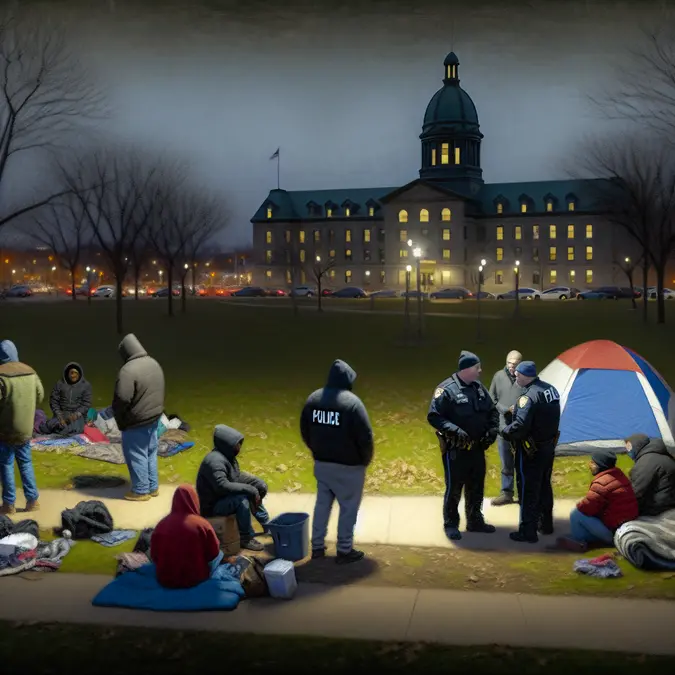
As the statewide homeless camping ban comes into effect, Terre Haute officials have begun explaining how enforcement will work on the ground. While the full operational details have not been made public, law enforcement agencies commonly pursue a stepped approach: verbal warnings, offers of transport to shelters or services, and, only as a last resort, citations or arrests.
Police leaders in many cities stress they do not want jails to become de facto shelters. However, without enough beds, mental health care, and addiction treatment, officers are frequently left with few alternatives when they receive calls about people sleeping in parks, under bridges, or near businesses. This is the enforcement paradox at the heart of many camping bans: the law demands action, but the social infrastructure to redirect people humanely is often incomplete.
Readers should also understand that Terre Haute is not unique. Similar debates have surfaced in cities across the Midwest and the nation. For example, several large cities have faced federal court scrutiny over their treatment of encampments. The U.S. Supreme Court’s 2024 ruling in City of Grants Pass v. Johnson narrowed protections for people experiencing homelessness, making it easier for local governments to enforce camping bans even when shelter is scarce. Legal analysts at Reuters have noted that this ruling may embolden more aggressive enforcement across the country.
Homeless camping ban and police discretion in local neighborhoods
How the homeless camping ban plays out will depend heavily on police discretion in everyday encounters. Officers responding to complaints about public camping must make rapid choices: Is this a situation for a warning and a referral to services, or a formal citation? Should a tent encampment near a school be treated differently from an isolated sleeping area under a highway overpass?
These questions are not purely legal. They go to the heart of how a city defines public order and public compassion. Many law enforcement leaders argue that clear state laws give them necessary tools to respond when public spaces become hazardous or unsanitary. Advocates for people experiencing homelessness counter that such laws risk turning poverty into a criminal status, especially when options for safe, legal sleeping are limited.
For cities like Terre Haute, which operate with constrained budgets and aging infrastructure, implementing the ban without deepening social harm will require careful coordination between police, shelters, public health agencies, and community organizations. Readers can explore related urban governance debates in our coverage under Politik and regional development analyses in Ekonomi.
Seven critical questions raised by Indiana’s homeless camping ban
Beyond Terre Haute, Indiana’s homeless camping ban raises at least seven critical questions that policymakers, residents, and business owners need to confront honestly.
1. Where can people legally sleep if shelters are full or inaccessible?
The most fundamental question is simple: if camping in public is illegal, where can unsheltered people go at night? In many communities, shelter capacity does not match the number of people experiencing homelessness. Bed availability may fluctuate daily, and strict entry rules, curfews, or sobriety requirements can block access for some individuals.
If no realistic alternatives exist, enforcement can function less as a pathway to safety and more as a mechanism of displacement. People may be forced into more hidden, dangerous locations to avoid detection, increasing risks of violence, exposure, or medical emergencies.
2. How will the homeless camping ban interact with constitutional rights?
Although the recent Supreme Court ruling has given cities more leeway, legal scholars continue to debate how far camping bans can go before they infringe on constitutional protections, such as the Eighth Amendment’s prohibition on cruel and unusual punishment or the Fourteenth Amendment’s due process guarantees. Additionally, First Amendment rights may be implicated if public spaces become less accessible to certain groups.
Courts and civil rights organizations will likely monitor how Indiana cities apply the homeless camping ban, particularly in cases involving people with disabilities, veterans, families with children, or individuals receiving federal benefits. Litigation risk increases if enforcement appears arbitrary or discriminatory.
3. Will enforcement reduce visible homelessness or simply move it?
Supporters of the law may hope that stricter rules will clear encampments from parks, downtown sidewalks, or near commercial corridors. In the short term, visible homelessness might indeed decrease in some high-traffic areas as sweeps occur. But research from cities such as Los Angeles, Denver, and Austin suggests that displaced residents rarely disappear; they relocate to new spaces, often with fewer eyes on them and weaker access to services.
This displacement effect can undermine public safety and public health. Outreach teams may struggle to keep track of vulnerable individuals, overdose risk can increase in remote spots, and emergency response times can lengthen. The result is a costly cycle of clearing, returning, and clearing again.
4. How much will the homeless camping ban cost taxpayers?
Enforcing a statewide homeless camping ban is not free. It demands officer time, court resources, jail space, and administrative work. Municipalities may need to update training manuals, develop data-tracking systems, and coordinate with social services. These expenditures can add up quickly. Studies cited by the Wikipedia overview on homelessness have consistently shown that policing and jailing people experiencing homelessness often costs more in the long run than providing stable housing combined with supportive services.
For fiscally conservative lawmakers and residents, this should matter. A dollar spent repeatedly on short-term enforcement is a dollar not available for permanent supportive housing, addiction treatment, or job placement programs that address root causes.
5. What role will service providers and nonprofits play?
Even the most enforcement-oriented approach to the homeless camping ban cannot function without coordination with shelters, churches, outreach teams, and nonprofit service providers. These organizations are often the entities that can offer transportation, connect people to health care, help them get identification documents, or navigate complicated benefit systems.
Terre Haute’s strategy, like that of other Indiana cities, will likely lean on these partners to absorb people displaced by camping enforcement. If their capacity is already stretched thin, the law may widen the gap between legal expectations and practical realities on the ground.
6. How will the law affect public health and community trust?
Public health experts warn that breaking up encampments without stable housing alternatives can worsen disease transmission, interrupt ongoing medical treatment, and disrupt relationships between outreach workers and clients. People living outdoors may lose medications, identification, or essential supplies during sweeps, each loss pushing recovery further out of reach.
Community trust is also at stake. When residents witness frequent crackdowns on individuals who appear vulnerable rather than dangerous, they may question local priorities and lose confidence in institutions. Conversely, when encampments appear unmanaged and persistent, others question whether leaders are willing or able to maintain safe public spaces. Navigating this tension will be a central test of Indiana’s approach to the homeless camping ban.
7. What long-term vision does Indiana have for homelessness policy?
Perhaps the most strategic question is what long-term vision state and local leaders have for homelessness policy. Camping bans answer an immediate political demand—”do something” about tents or people sleeping in public. But they do not, on their own, build new housing units, expand mental health care, or create living-wage jobs.
Evidence from communities that have successfully reduced homelessness over time points to a mix of Housing First initiatives, targeted prevention programs, robust behavioral health systems, and close coordination between government and civil society. If Indiana’s homeless camping ban is not accompanied by such investments, it risks becoming a revolving door, not a solution.
Balancing safety, dignity, and law in Terre Haute and beyond
As July 1 approaches, Terre Haute offers a focused case study in how a mid-sized city responds to a statewide mandate on homelessness and public space. City officials must walk a narrow line between enforcing the law, respecting basic human dignity, and protecting the collective use of parks, sidewalks, and civic areas.
We can expect several early indicators to reveal whether the implementation of the homeless camping ban is moving in a constructive direction:
- Clarity of communication – Are residents, business owners, and people experiencing homelessness informed about what the law does and does not allow?
- Consistency of enforcement – Are similar situations treated similarly, regardless of neighborhood or individual background?
- Availability of alternatives – Do people who are displaced receive real offers of shelter, services, and transportation, or simply a warning to “move on”?
- Data transparency – Will the city publish basic statistics on warnings, citations, arrests, and referrals to services?
These metrics, while technical, carry moral weight. They define how a community chooses to see and respond to some of its most vulnerable residents. As readers, we should pay attention not only to political rhetoric, but also to the data and lived experiences behind the numbers.
The measure of a city is not only how safe its parks and sidewalks feel, but also how it treats those who have nowhere else to sleep.
Conclusion: Why the homeless camping ban matters for Indiana’s future
The statewide homeless camping ban is more than a technical adjustment to Indiana’s legal code. It is a statement about how the state intends to manage visible poverty, contested public spaces, and the intersection of law enforcement with social services. Terre Haute’s approach to the new law will offer early lessons: Will the city lean primarily on citations and displacement, or will it combine enforcement with serious investments in housing and support?
For policymakers, advocates, and everyday residents, the stakes are high. The outcomes will shape not only downtown business corridors and neighborhood parks, but also the life chances of people who are already on society’s margins. As Indiana moves forward, the challenge will be to ensure that the homeless camping ban becomes a catalyst for more thoughtful, humane policy — not merely a new tool for pushing the problem out of sight.